
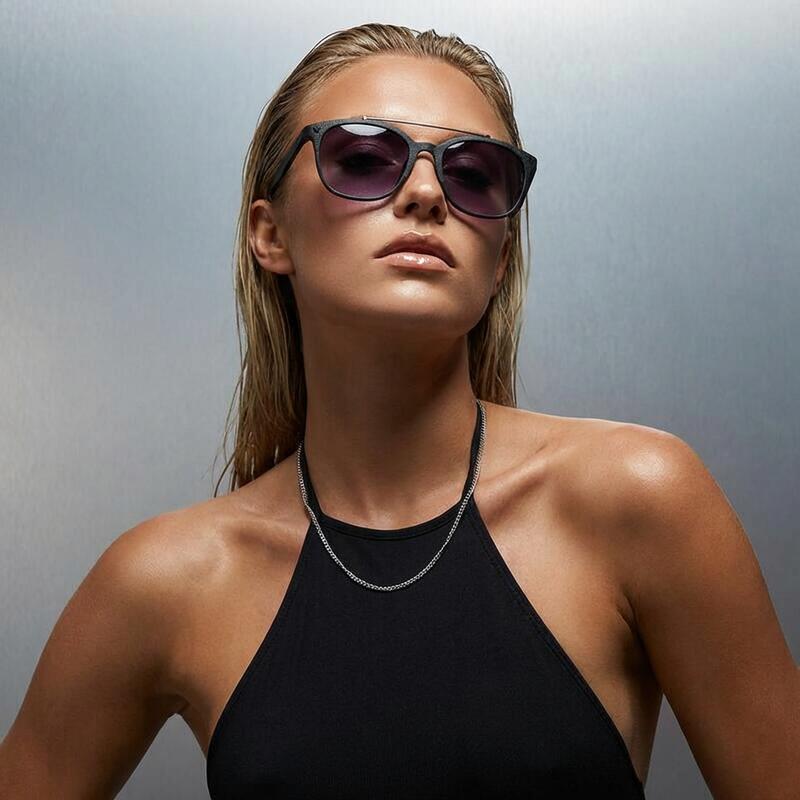
"Black" is a process, not a color
Here's the section that separates the pairs that last. A metal frame doesn't come out of the ground black; it gets blackened, and there are three main ways to do it — with three very different lifespans.
Lacquer or spray coating is the budget route: black paint over raw metal. It photographs identically to every other method, and it fails first at the friction points — hinge corners, nose-pad arms, the spot where the temples fold against the frame. That's why a cheap black aviator's tell is silver creeping through at the hinges while the rest of the frame still looks fine.
Electroplating bonds a colored layer to the metal in a chemical bath. Better adhesion than paint, and the standard at mid-range prices. Wear shows up slower and more evenly.
IP plating (ion plating, sometimes listed as PVD) deposits the finish in a vacuum chamber, molecule by molecule. It's the same process used on black watch cases, and it's the most durable black finish you can buy on metal eyewear. When a listing specifically says "IP-plated" or "PVD finish," that's a real spec, not adjectives — manufacturers who pay for the process name it.
The vocabulary is your clue. "Matte black finish" describes how the frame looks and tells you nothing about how it was made. "IP-plated stainless steel" tells you both.
There's also a way to opt out of the whole question: acetate. A black acetate aviator is black all the way through the material, so there's nothing to chip and no silver waiting underneath. Fine scratches in acetate can even be polished out. The trade is bulk — acetate aviators run thicker and heavier-looking than wire frames, which changes the character of the shape. Neither is wrong; just know that with acetate you're buying permanence of color, and with metal you're buying the classic silhouette plus whatever finish process the maker chose.
One last finish note: matte coatings wear by going shiny at contact points, gloss wears by showing fine scratches. Both are cosmetic, not structural — but if you're hard on your glasses, that's worth knowing before you pick.

Read the lens spec, not the lens adjectives
Which tint to put on a black frame — grey, green, brown, mirror — is a style-and-use question, and we cover it on the black aviator sunglasses collection page itself. What belongs in a buying guide is the part listings gloss over: what the lens is made of, because that's where quality actually diverges.
Start with what doesn't diverge. Sunglasses sold in the U.S. have to meet the FDA's impact-resistance requirement, and UV-protection claims are governed by the ANSI Z80.3 standard. UV400 blocking is inexpensive chemistry — a $20 pair and a $200 pair can both deliver it fully, and "UV protection" on the box is table stakes, not a premium feature. If a listing treats UV400 as its headline selling point, that's the eyewear equivalent of a restaurant advertising that its food is safe to eat.
Where lenses genuinely differ:
Polycarbonate is light and close to unbreakable, which is why it dominates at accessible prices and in kids' and sport eyewear. Its softness means it depends on its hard coat to resist scratches, and its optics blur slightly at the far edges of a lens — more noticeable on a big teardrop than on a small rectangular lens.
CR-39 (a hard resin that predates polycarbonate) gives noticeably crisper optics and takes tint beautifully, at the cost of weight and impact resistance. It's the quiet favorite for people who care how the world looks through the lens.
Nylon (polyamide) splits the difference — light like polycarbonate, sharp like CR-39 — which is why performance brands lean on it.
TAC is a laminated film lens common in budget polarized sunglasses. The optics are fine out of the box; the risk is delamination, where the layers separate at the edges after heat and time. If you've ever seen a polarized lens develop a rainbow-oil-slick patch, that was TAC letting go.
Mineral glass is the sharpest and most scratch-resistant of all — and heavy enough that on a full-size aviator lens you'll feel it on your nose by afternoon, with the obvious caveat that glass can shatter.
Two coating lines worth looking for on a large dark lens: a backside anti-reflective coating, which kills the mirror effect of your own eyes bouncing off the inside of a dark lens (a bigger annoyance on aviators than on smaller shapes, because there's more lens behind you), and a hydrophobic layer if you're around water. As for polarization: on a well-made lens the polarizing filter is invisible and permanent; on a cheap laminated lens it's another layer waiting to separate. Polarization is only as good as the lens construction carrying it.
Hardware is where a listing tells on itself
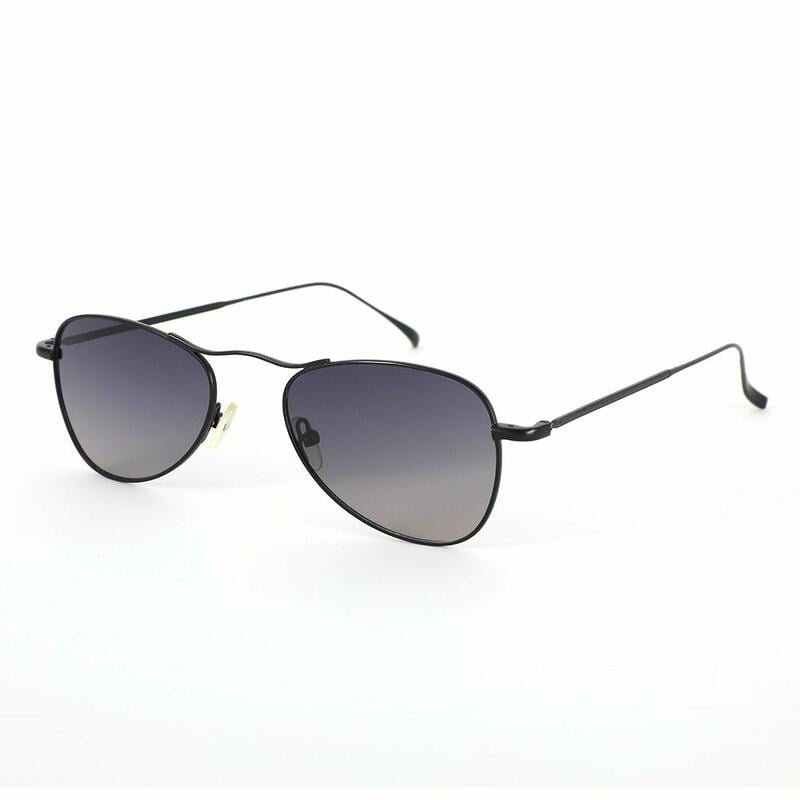
Frames fail at their moving parts, and moving parts are exactly what product photography avoids. If the listing offers detail shots, here's what to read in them.
Hinges. Standard barrel hinges — the interlocking knuckles a screw runs through — are honest, repairable technology; more and larger barrels mean more bearing surface. Spring hinges add flex so the temples give instead of snapping when you pull the glasses off one-handed, a genuine comfort upgrade on thin aviator temples, with the trade-off of more small parts to eventually wear.
Joints. An aviator has more soldered connections than most frames — brow bar to rim, bridge to rim, hinge to rim. On a well-made pair the joints are smooth and nearly invisible under the finish; visible solder blobs or rough transitions are a preview of the overall tolerance the factory works to.
Nose pads. Silicone pads grip well (good for staying put, and slightly tacky against skin); harder PVC pads slide more when you sweat but keep their look longer. What matters more than the material is the arm behind the pad: adjustable pad arms are the reason a metal aviator can be tuned to sit at exactly the right height on your face, and they're half the fit equation. If your aviators have ever slid down all day, adjustable pads — not a smaller size — were probably the fix.
Weight. If the listing states it, use it. A full-size metal aviator in the mid-20-gram range wears light; past the mid-30s you'll know it's there. Where that weight sits is the bridge's job — which loops back to why the middle number in the size string earns its place.

Putting a prescription in a black aviator
Aviators have a reputation as a "sunglasses-only" shape, and it's outdated. Two things are true at once, and a good buying decision needs both.
The good news: that deep teardrop lens is generous real estate. Progressive lenses, which need vertical room for the corridor between distance and reading zones, fit an aviator more comfortably than they fit the shallow rectangular frames that dominate offices. If you've been told your lens was "too short" for progressives, an aviator is the opposite problem in the best way.
The catch: lens size cuts both ways. If you have a strong single-vision prescription — particularly a high minus — a bigger lens means the lens edge sits farther from your eye's center, and edge thickness grows with distance. A moderate prescription in a mid-size aviator is a non-issue.
And here's the part that's specific to this page: a black frame is the most forgiving home for a strong prescription. A thick lens edge shows as a bright ring where light catches it; against a thin gold or silver rim, that ring stands out. A black rim visually absorbs the lens edge into the frame line. Of all the reasons to choose black aviators, this is the one nobody's listing mentions — and for high prescriptions it's arguably the most practical.
Ordering them is the easy part: pick the frame, upload your prescription at checkout, choose single vision, bifocal, or progressive. Every pair Aoolia ships — prescription sunglasses or plain — is checked by a licensed optician before it goes in the box: alignment, lens quality, UV rating.
What more money actually buys — and what it doesn't
Since black aviators exist at every price from gas-station rack to luxury counter, it's fair to end a buying guide here.
More money does not buy UV protection (regulated and cheap), the word "polarized" (available at every tier), or the shape itself (the teardrop silhouette belongs to no one — every brand sells it). Those are the three things listings most often dress up as premium.
More money can buy: an IP-plated finish instead of paint, a lens material upgrade, tighter assembly tolerances at the joints and hinges, and — at luxury prices — a licensing margin that has nothing to do with the object on your face.
Which leaves the honest question for any pair at any price: did a qualified human check this one before it shipped? That verification step is where quality control actually lives, it's the step mass retail skips, and it's the one we've built into every order rather than into the price tag.

The short version
Read the three numbers against a pair you already own. Prefer a named finish process over a described color. Ask what the lens is made of, not just what it blocks. Look at the hinges before you look at the model photos. And if you wear a prescription, remember that black is the frame color that hides lens edges best — the rare case where the stylish choice and the optical one are the same pair. When you're ready to compare real frames instead of theory, the full black aviator sunglasses collection has virtual try-on on every model, and the broader aviator sunglasses range covers every other finish the shape comes in.