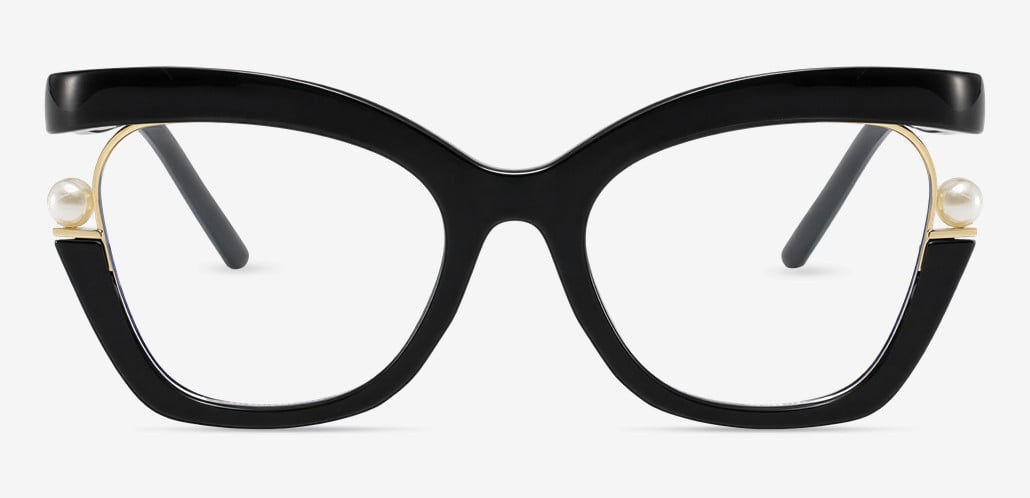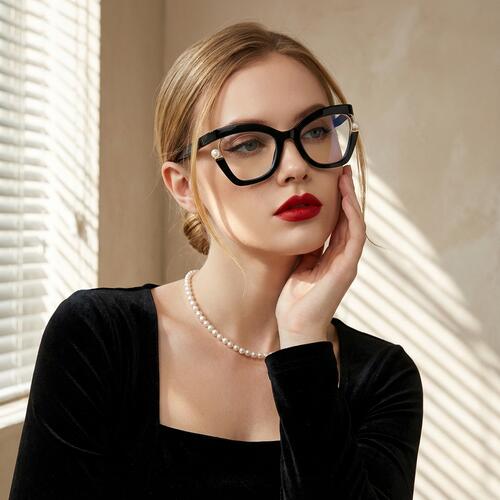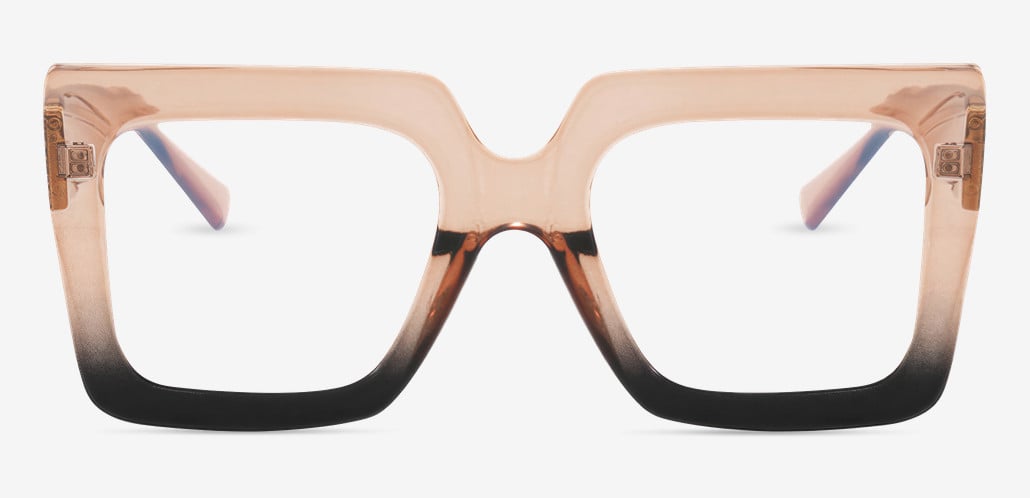

There is a detail in The Wonderful Wizard of Oz that almost nobody who has only seen the 1939 film knows about, because the film cut it: in L. Frank Baum's 1900 novel, nobody gets into the Emerald City without a pair of green glasses locked onto their face.
Not handed. Locked. Two gold bands run around the back of the head and fasten with a key that the Guardian of the Gates keeps on a chain around his neck. Dorothy gets a pair. So do the Scarecrow, the Tin Woodman, and the Lion. So does Toto. The Guardian explains that the brilliance of the city would blind anyone who walked in unprotected, and that the residents wear theirs day and night.
It is a strange, funny, slightly sinister piece of world-building, and it is also — accidentally or not — a reasonably accurate description of what a tinted lens does to human vision. Which is worth knowing if you have been shopping for Elphaba glasses, or green frames, or a tinted prescription lens of any kind, and you are trying to work out what you would actually be buying.
The joke Baum was telling
Five chapters later, the Wizard confesses. He is not a wizard, he is a man from Omaha who arrived by balloon, and the city is not made of emeralds. It is an ordinary city. He had green spectacles locked onto everyone's face when it was built, and after enough years of that, the residents simply believe the place is green.
So the stated reason for the glasses — glare protection — is the lie. The real function is color. The Guardian's line about brilliance is the cover story, and Baum leaves it to the reader to notice that a city that needs eye protection to look at should not also need tinted lenses to look green.
This is, structurally, the same idea the Wicked musical and films are built on: the official story about Oz and the actual mechanics of Oz are not the same thing. Gregory Maguire named his green-skinned protagonist Elphaba after Baum's own initials — L. F. B. — which tells you how deliberately the 1995 novel was built on top of the 1900 one.

What a green tint actually does to what you see
Baum was writing forty years before anyone standardized how we measure this, but the underlying optics holds up better than you would expect.
It filters, it does not add. A tinted lens works by absorption. Green tint absorbs a portion of the short-wavelength (blue) and long-wavelength (red) light before it reaches your eye and lets the middle of the spectrum through. Nothing is added. This is why the Guardian's explanation is doubly dishonest — a green lens makes the world dimmer, not safer to look at because it's too bright. If the city were genuinely dazzling, a green tint would help. But it would also not make white marble look emerald. Both effects cannot be the reason.
Green is the least costly color to filter to. Human daytime vision is most sensitive to light at roughly 555 nanometers, which sits in the yellow-green part of the spectrum. A green tint sits right on that peak, so it removes less perceived brightness per unit of light blocked than a blue or red tint of the same density. A 50% green lens feels lighter on the eye than a 50% blue one. Baum picked, by luck or instinct, the one tint color that could plausibly be worn day and night without people walking into walls.
Whites take the cast first. A neutral white surface reflects across the whole spectrum, so it carries the tint most visibly. Colored surfaces are partly filtered already. That is why the fiction works: white stone under a saturated green lens reads green, while a red apple mostly reads dark and muddy. Baum's Emerald City is described as gleaming and pale under all that green — which is exactly the surface that would take the tint hardest.

The part Baum got right without knowing it
Here is the detail that makes the Emerald City setup more than a gag, and it is the single most useful thing in this article if you are about to order tinted lenses.
The residents stop noticing.
Your visual system does not report raw wavelength data. It continuously re-normalizes what it treats as neutral based on the average of what you are looking at — the mechanism usually called chromatic adaptation, and the reason a white shirt looks white to you under warm indoor bulbs and under overcast daylight even though the light hitting it is wildly different. Put a strong color filter in front of the eye and, within minutes, the visual system starts pulling its idea of "neutral" toward the filtered average. The cast does not disappear, but it fades substantially.
Anyone who wears tinted lenses knows the practical version of this: the tint is loud for the first ten minutes and then becomes close to invisible, and the moment you take them off the world looks briefly, absurdly pink. Baum's citizens have worn theirs for years. Of course they think the city is green.
Why this matters when you are buying: the tint you judge in the first thirty seconds is not the tint you will live with. Almost everyone who buys tinted lenses for the first time overcorrects — they pick a density that looks convincing on day one and find it flat and pointless by week two, or they pick something subtle and never see it again after the first walk outside. If you are choosing between a light and a medium tint and you cannot decide, the medium is usually the one people keep wearing.
Where Elphaba glasses fit into this
The search term Elphaba glasses covers three different things, and the green-glasses history explains why they get tangled up.
The frames from the film. Oversized, round, thin dark rim, with an asymmetric line curving over one lens. They are not green. The frames are dark; the green is her skin.
The frames from the stage production. Slimmer, longer, closer to a plain wire round. Also not green.
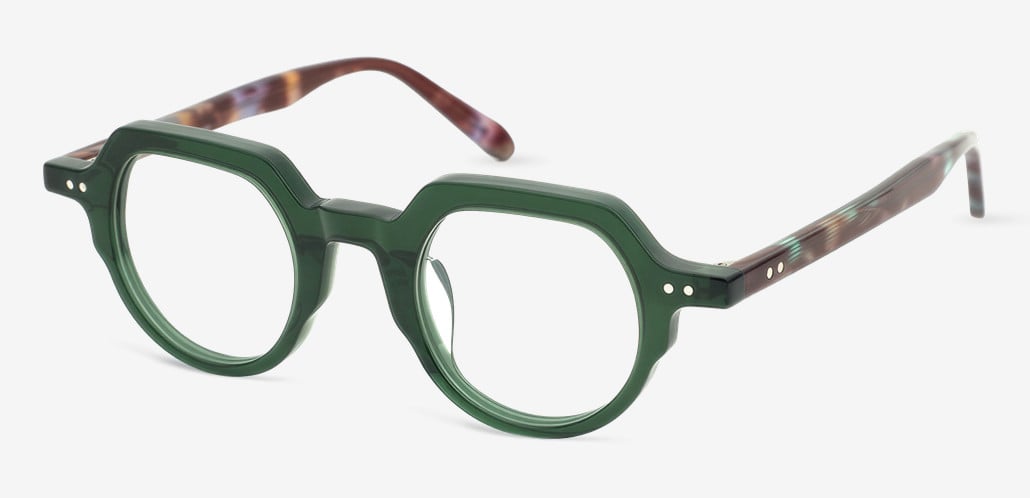
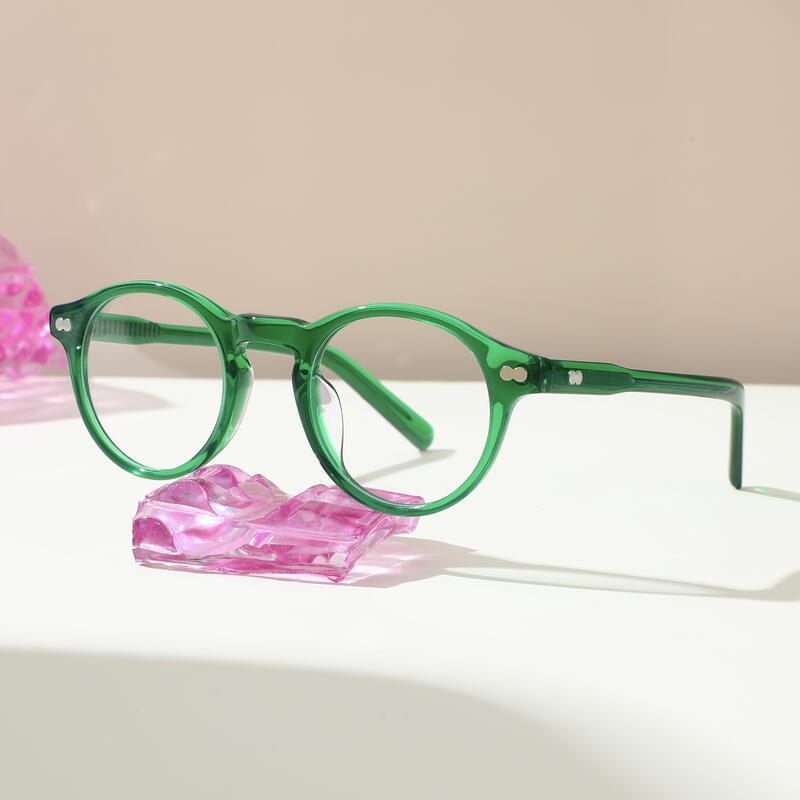
Green anything. This is where the confusion comes from, and it predates the musical by ninety-five years. Green is Oz's color, and Baum put it on people's faces in chapter ten. So a lot of people searching for Elphaba glasses end up looking at green frames, which is a reasonable instinct pointed at the wrong component.
If the green is what you actually want, the source material is on the side of the lens, not the frame. A clear or dark round frame with a green-tinted lens is a closer reference to Baum's Emerald City than a green plastic frame is — and it has the practical advantage of reading as an intentional styling choice rather than a costume element, which matters if you plan to wear the thing in November.
Choosing a tint density without guessing
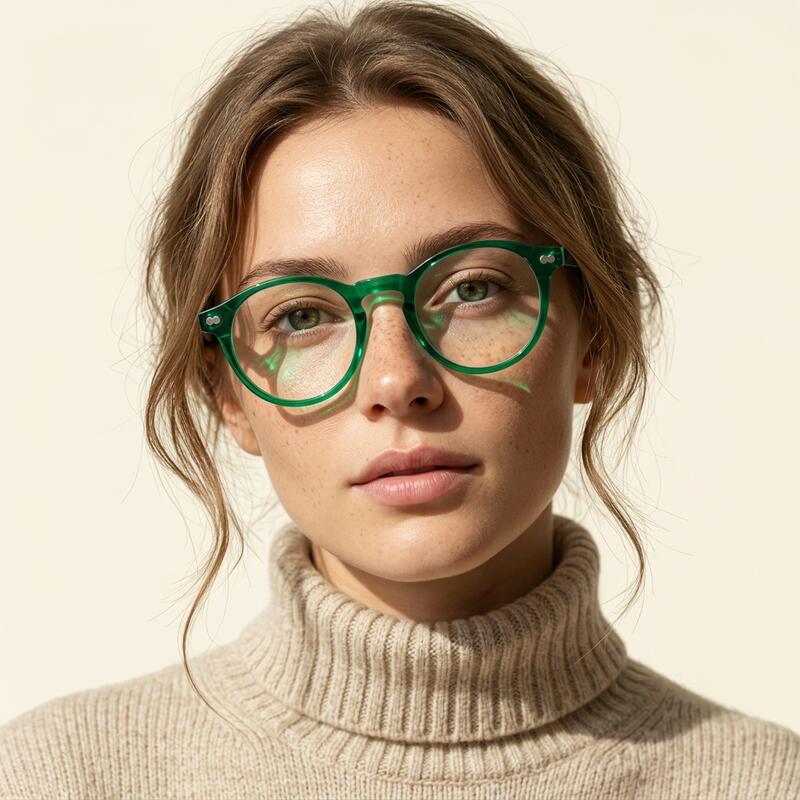
Tint is sold by percentage, which describes how much light the lens absorbs. Higher number, darker lens. The ranges below are the ones that actually get worn:
10–25% — a wash. Visible in photographs, barely visible on your face at conversational distance. Comfortable indoors, does nothing outdoors. This is the range people buy when they want the reference without the commitment. It is also the range most often described as "why did I bother" after a month.
30–50% — the useful middle. Reads clearly as tinted, still fine indoors on a bright day, cuts genuine glare outdoors without becoming sunglasses. If you want green lenses you can wear at a desk and then walk outside in, this is the band. Most people who end up happy with a fashion tint land here.
60–75% — light sunglass. Now it is a sunglass. Wearable indoors only in the sense that you can technically see. Good for overcast-to-bright outdoor use.
80–85% — full sunglass. Standard sunglass density. Beyond about 85% you are into specialty territory and should not be driving in them.
Two practical notes that catalogs rarely mention:
Gradient versus solid. A gradient tint is dark at the top and clears toward the bottom. On a large round lens — which is what most Elphaba glasses are — a gradient can look uneven, because the round shape puts the transition line through the widest part of the lens rather than across a narrow band. Solid tints usually sit better on round frames. Gradients suit rectangles and aviators, where the geometry hides the transition.
Not every lens takes tint the same way. Standard plastic lenses absorb dye readily and evenly. Polycarbonate and high-index materials are harder to tint deeply and can come out lighter than the number you selected, particularly above 50%. If you have a strong prescription and want a dark tint, say so when you order — the combination is doable, but it is worth confirming rather than discovering.

When green tint is a bad idea
This is the section most articles about tinted lenses skip, and it is the one with actual consequences.
Driving. Traffic signals are one of the few real-world situations where correctly identifying a color is safety-critical, and a strongly saturated tint interferes with exactly that. Green and red tints are the worst offenders because they push the two signal colors toward each other. A light green tint is not a problem. A heavily saturated one is a genuinely poor choice for driving, and no tint of any color should be worn for night driving. If you want lenses for the car, gray preserves color relationships better than anything else, and a light gradient handles windshield glare well.
Color-dependent work. Anyone matching paint, grading photographs, reading color-coded wiring, or doing anything where a hue judgment has to be right should not do it through a saturated tint, adaptation or no adaptation. Adaptation makes the cast feel like it has gone. It does not restore the wavelengths the lens removed.
As a substitute for real glare control. A tint reduces overall brightness. It does not selectively cut reflected glare off water, wet asphalt, or snow — polarization does that, and it is a separate option. People buy dark tints expecting polarized performance and are consistently disappointed.
If you only need it for one night
A large share of the people searching for Elphaba glasses in October want a costume, not eyewear, and there is no reason to overthink it — but there is one thing worth knowing before you buy the $12 version.
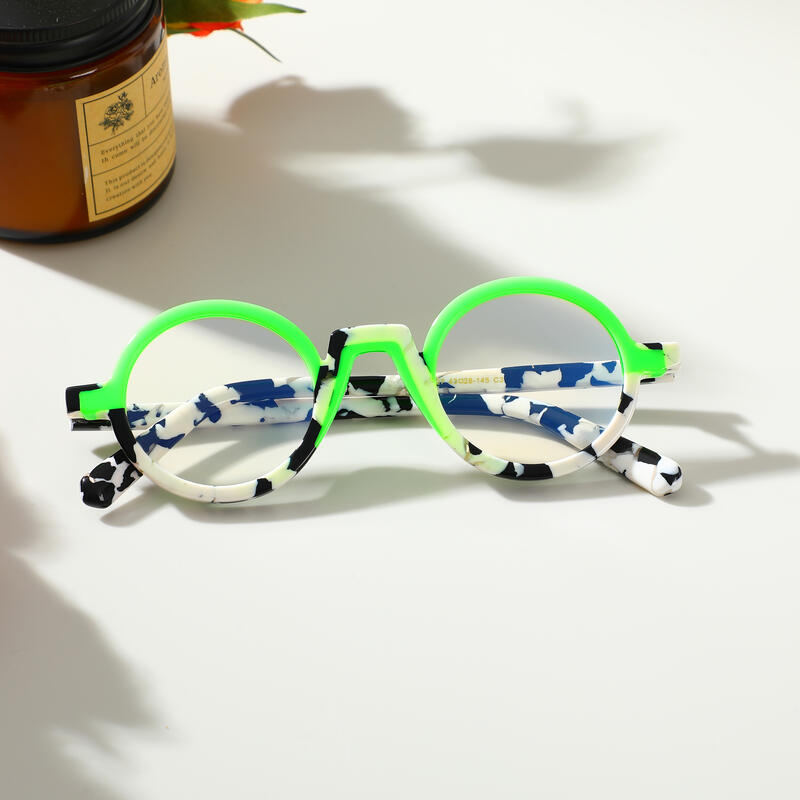
Most costume glasses are not optical frames. The lenses are acrylic panels pressed into a groove-less rim, and no lab can replace them. If there is any chance you will want to put a prescription in the frame later, or add a tint later, buy an actual optical frame with a clear non-prescription lens instead. It costs more up front and it stops being disposable in November.
That is the whole practical difference between a costume prop and a frame, and it is the same difference the Guardian of the Gates was quietly exploiting: what a pair of glasses is for, and what you are told it is for, are not always the same thing.
Aoolia's round and oversized round frames all take prescription, non-prescription, and tinted lenses, including green. Every order is checked by a qualified optician before the lenses are cut.