
The pairs on screen weren't what you think
The most photographed glasses of the last twenty-five years were, for a lot of shots, an empty frame.
Film lighting is unforgiving to eyewear. A flat piece of glass or plastic in front of an actor's eyes catches every key light in the room, and the reflection lands right where the audience is looking. Wired reported that some versions of the screen glasses were built without lenses specifically to kill those reflections, and eagle-eyed viewers have pointed to the same evidence for years: no refraction at the edges of the face, and water that runs across the frame instead of beading on a lens.
There's a second tell that fans have latched onto. A real corrective lens distorts the image leaving your face as well as the one entering your eye — which is why a nearsighted person's eyes look slightly smaller behind their glasses, and a farsighted person's look larger. That distortion never shows up on screen, because there was nothing there to cause it.
Radcliffe has also said he went through a very large number of pairs across the eight films — the number usually quoted is around 160 — partly because he turned out to be allergic to the nickel in the original metal rims and the props had to be remade in something his skin tolerated.
That last detail is more useful than it sounds, and we'll come back to it.
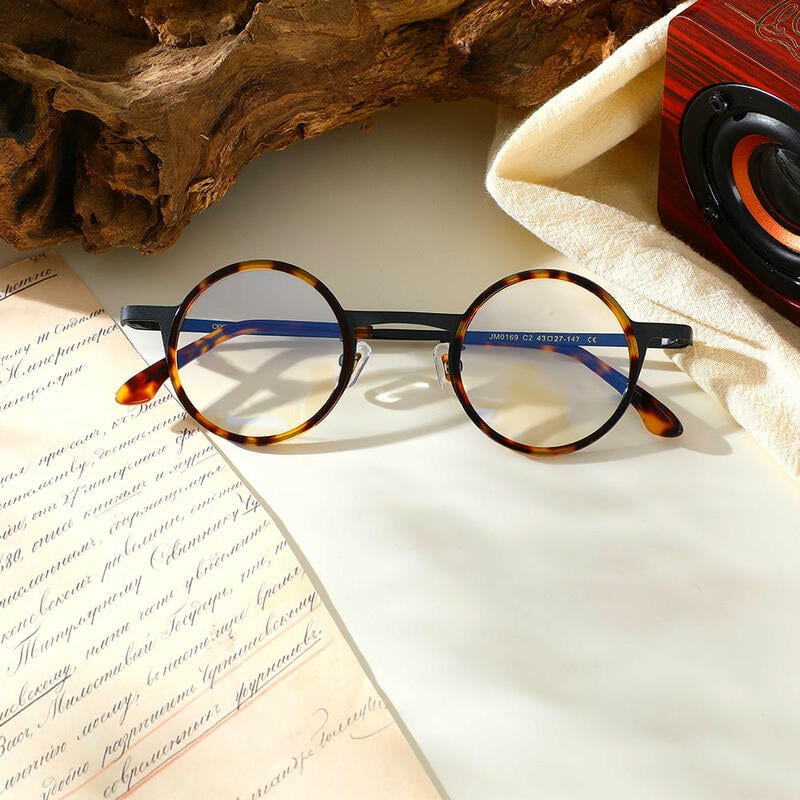
Is the pair you're about to buy a real pair of glasses?
This is the question that actually costs people money. A lot of round black frames sold under this description are costume accessories, and the listing photo looks identical to a $60 optical frame. The difference shows up the moment you try to do anything with them.
You can tell in about thirty seconds. Five things to check:
1. Look inside the temple arm for numbers.
Every genuine optical frame in the world carries its measurements stamped or
printed somewhere on the inside of the temple or across the bridge. They look
like 44 □ 22 - 145 — lens width, bridge width, temple length, in millimetres.
No numbers anywhere on the frame is the single strongest sign you're holding a
costume piece. Optical labs need those figures; props don't have them because
nobody was ever going to cut a lens for them.
2. Check the hinge for a screw. Real frames use a screwed hinge, because the arms need to be removed and re-tensioned over the life of the glasses. Costume frames are usually riveted, press-fitted, or moulded in one piece. A moulded hinge can't be adjusted, and when it snaps — and it will — there's nothing to repair.
3. Look at the inside edge of the rim. An optical frame has a groove cut around the inside of the rim. The lens is bevelled to a matching ridge and snaps into that channel. Hold the frame up to the light and look at the rim from the inside; if the edge is flat and smooth with no channel, no lens is going into it. Ever.
4. Ask what it's made of. Acetate, TR90, metal and titanium can all be gently heated or bent to adjust the fit to your face. Injection-moulded ABS — which is what most $10 costume frames are — cannot. Heat it and it deforms; bend it and it cracks. This is why prop glasses always sit slightly wrong and never stop sitting slightly wrong.
5. Check whether the nose pads move. On a metal frame, adjustable pad arms are standard. On a costume frame the nose piece is usually part of the same moulding as the front. Round frames depend heavily on sitting at the right height — more on that below — so a nose bridge you can't adjust is a bigger problem here than on a rectangular frame.
If a frame fails three or more of these, it's a photo prop. That's a perfectly good thing to be, if a photo is what you need it for.

"Can't I just take them to an optician and have lenses put in?"
Sometimes. More often than people expect, the answer is no — and it's worth understanding why before you spend money on a frame hoping to convert it later.
An optical dispenser fitting lenses into a frame you supply is taking on the risk of that frame. If the rim has no groove, the job is impossible. If the hinge is riveted, they can't disassemble it to work on it. If the material can't take heat, they can't insert the lens without cracking the front, since most rim-and-lens insertions involve warming the frame slightly. Many shops will simply decline, and the ones that accept usually ask you to sign a waiver accepting that they aren't responsible if the frame breaks during fitting.
Then there's the arithmetic. Lens-only jobs on a customer-supplied frame are priced as a standalone service, and in the US they commonly land between $90 and $250 depending on the prescription and coatings. A complete pair — frame and lenses together — from an online optical retailer often costs less than the lens job alone. Buying a $12 costume frame and converting it is, in most cases, the most expensive route to the same result.

Getting the look as an actual pair of glasses
If what you want is the shape, and you want to see through it, you're looking for four specifications. Colour is negotiable; these mostly aren't.
A true circle. Lens width and lens height within about 2mm of each other. Ovals and rounded squares don't read the same way.
42–46mm lens width. This is small by current standards, which is exactly why the silhouette is recognisable. Above 48mm it stops looking like this and starts looking like the 1970s.
A thin rim. Wire around 1.2–1.6mm, or the slimmest acetate available. Rim thickness destroys the effect faster than any other single variable — a chunky round frame reads as a completely different style.
A keyhole or saddle bridge, in black or gunmetal. This is the detail most people can't name but immediately notice when it's missing.
Now the part almost nobody covers.
Round frames and your prescription
Round lenses behave differently from rectangular ones, and it matters more than the marketing on most sites suggests.
Single vision is easy — and small round lenses are actually an advantage. Lens thickness at the edge grows with the diameter of the lens and the strength of the prescription. A −5.00 cut into a 44mm circle has far less edge thickness than the same power cut into a 54mm rectangle. If you have a strong prescription and have been steered toward large frames, this style is worth a second look.
Progressives need vertical room. A progressive lens stacks distance, intermediate and reading zones down the height of the lens. As a working figure, about 28mm of lens height is the floor for a standard progressive design, with short-corridor designs going lower. Plenty of 44mm round frames measure 38–40mm tall and are completely fine. The smallest, most perfectly circular ones can fall under the line — which is why the lens height number matters more than the frame photo, and why it's worth buying from somewhere that publishes it.
Optical centre is less forgiving on a circle. Your pupillary distance determines where the optical centre of each lens sits. On a rectangular lens there's a straight top and bottom edge to reference against; on a circle there isn't. A PD that's off by 2–3mm produces noticeable eye strain here that you might get away with in a wider frame. Take the PD from your prescription if it's printed there rather than estimating it.
Total frame width decides fit, not face shape. Small round frames run narrow across the front. If your current glasses measure more than roughly 138mm across, most 44mm rounds will press at the temples and slide down your nose no matter how well the bridge fits.
And that nickel detail
Worth knowing if you're buying metal: nickel is the most common contact allergen in the world, and inexpensive metal frames frequently contain it in the alloy or the plating. If you've ever reacted to costume jewellery or a watch back, choose titanium, stainless steel, or acetate. Titanium in particular gives you the thin-wire silhouette at under 12 grams with no nickel content at all.
What about the officially licensed collections?
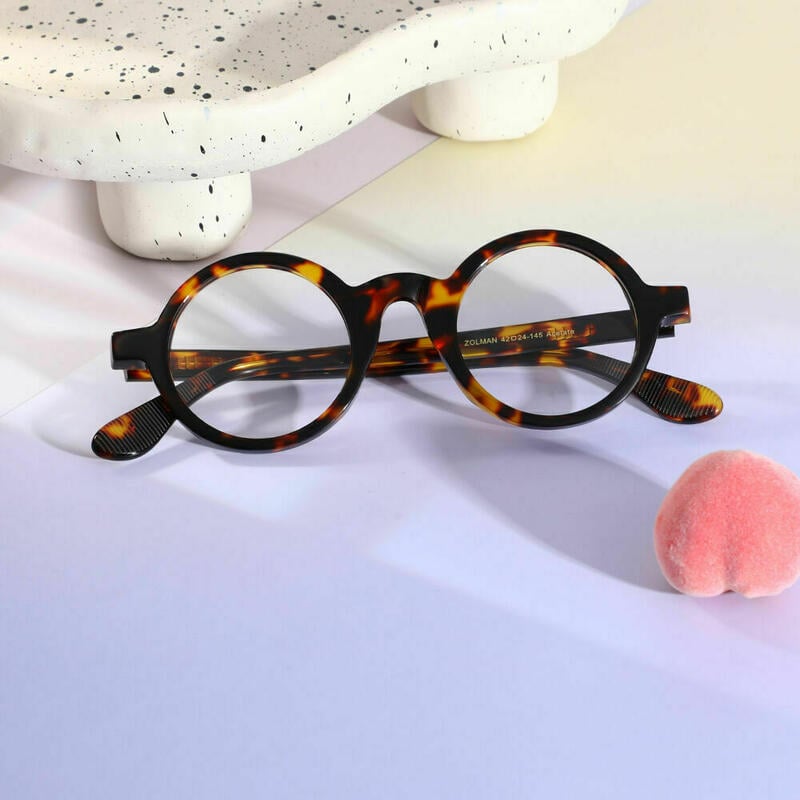
They exist, and they're the real thing. Warner Bros. licenses eyewear based on the films, and DIFF Eyewear holds that licence in the US — those collections are sold through their own site and through retailers including SmartBuyGlasses and GlassesUSA. The frames carry themed detailing, house references, and branded packaging, and they generally price above $100 before lenses.
Whether that's worth it comes down to what you're buying. If you want the branding, the packaging and the licensed detailing, buy the licensed pair — nothing else will give you that. If what you want is the round wire silhouette as a pair of glasses you'll wear every day, the shape isn't proprietary, and you can get a well-made optical frame in that geometry for a fraction of the price.
If you don't need vision correction
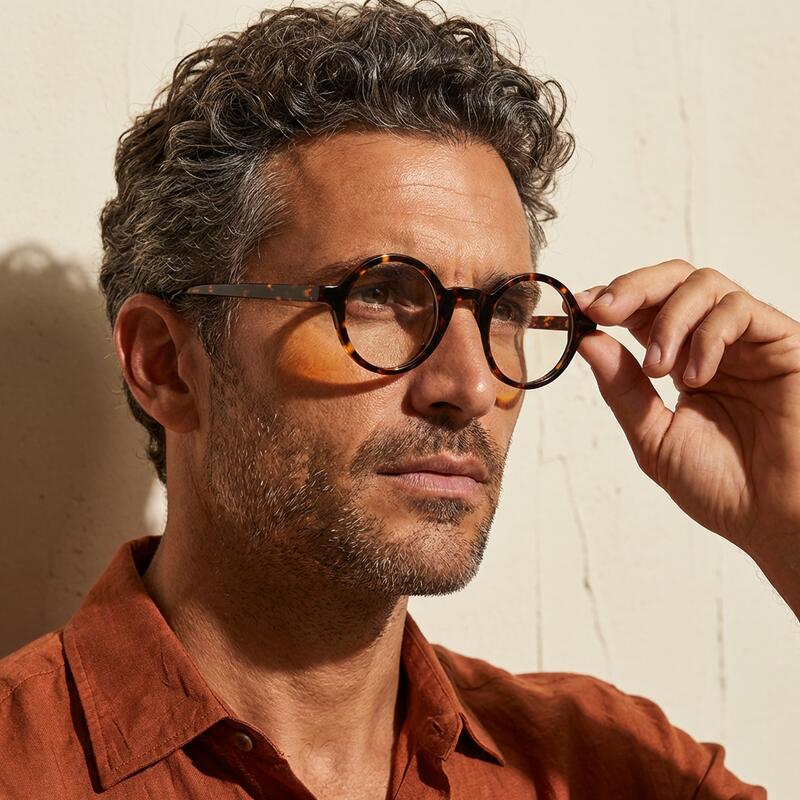
You still don't want a prop. Ordering a real optical frame with plain non-prescription lenses gets you optically clear, properly finished lenses in a frame with screwed hinges and an adjustable fit — no edge distortion, no warping, and something you can keep wearing after the event. It costs more than a costume pair and less than almost anyone expects.
The short version
The screen pairs were props, and many had no lenses at all.
Most costume versions are not optical frames and cannot be fitted with a prescription. Check for stamped measurements, a screwed hinge and a lens groove.
Converting a costume frame usually costs more than buying a complete pair.
The look comes from four specs: true circle, 42–46mm, thin rim, keyhole bridge.
Single vision works beautifully in small round frames. Progressives need around 28mm of lens height — check the number before you buy.
Licensed collections are worth it for the branding. The shape itself isn't proprietary.
Every frame in Aoolia's round glasses collection is a real optical frame with its measurements and true lens height published on the product page, and every prescription order is checked by a qualified optician before it's cut. You can browse the round wire styles in Harry Potter style glasses, or order any frame with non-prescription lenses if you just want the look.
Aoolia is not affiliated with, endorsed by, or sponsored by Warner Bros. Entertainment Inc. "Harry Potter" is a registered trademark of its respective owner and is used here only to describe a frame style.