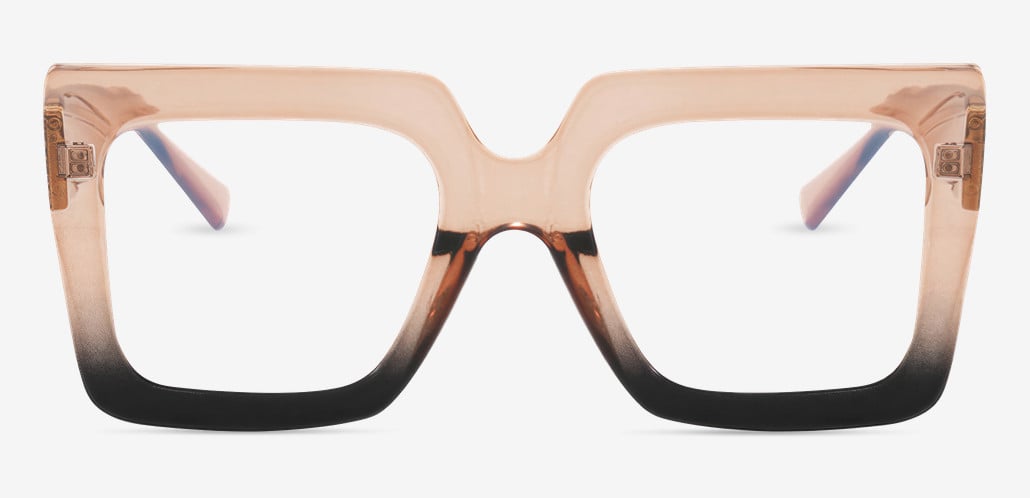

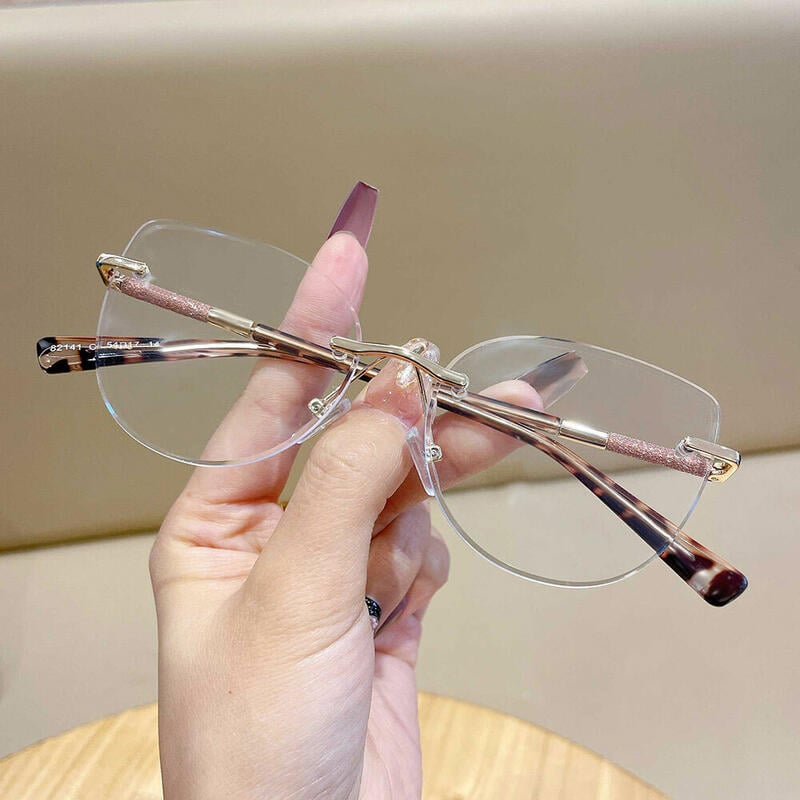
Pick up a pair of rimless glasses and the first thing you notice is what isn't there. No frame circling the lenses. No acetate, no wire rim, no color blocking your face. Just two lenses, a bridge, and two temples, held together at four small drilled points. That absence is the whole appeal — and it's also the reason buying rimless works a little differently than buying any other style of glasses.
Most articles about rimless glasses for women stop at "they're lightweight and elegant." True, and not very useful. What actually determines whether you'll love a rimless pair is a handful of practical details — your prescription strength, the lens material you choose at checkout, how the mounts are assembled, and how you treat them in year two. This piece walks through the life of a rimless pair in order: what to check before you buy, the decisions that happen at checkout, what the first week feels like, and what ownership looks like years down the road.
Before you buy: your prescription sets the rules
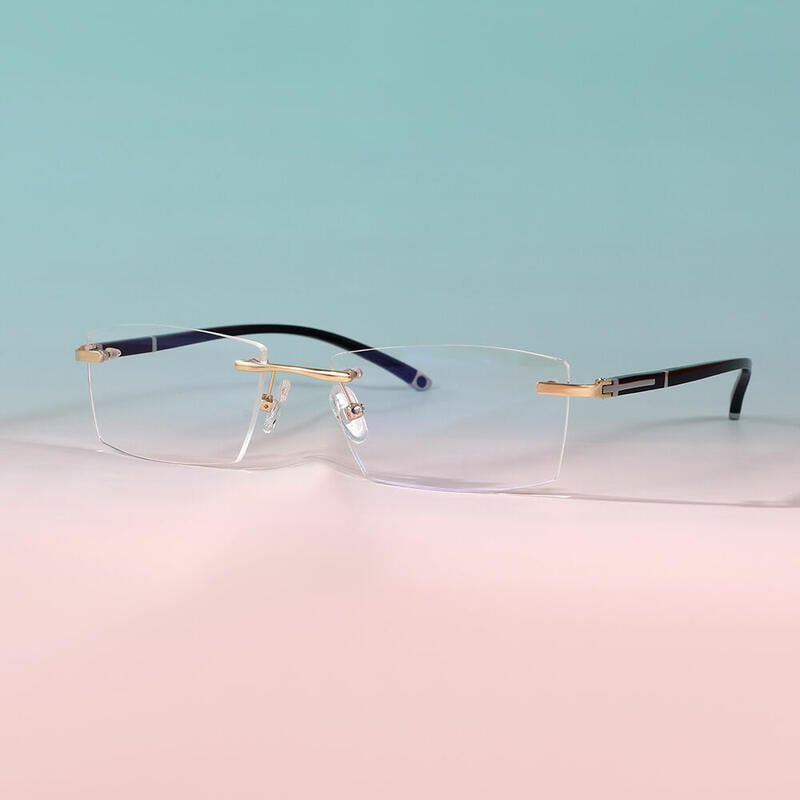
With a full-rim frame, your lens hides inside the rim. With rimless, the lens is fully exposed — every millimeter of edge thickness is visible from the side. That's why the single most important pre-purchase question isn't about style at all. It's: how strong is your prescription?
Here's the practical math. Standard lenses (index 1.50) get noticeably thick at the edges once a prescription passes roughly -3.00 to -4.00. On a full-rim frame, nobody sees it. On a rimless frame, everybody does. The fix is a high-index lens — 1.67 or 1.74 — which bends light more efficiently and stays thin even at stronger corrections. If your prescription sits between -4.00 and -8.00, budget for 1.67 at minimum. Farsighted prescriptions (plus powers) thicken at the center rather than the edge, which rimless actually handles gracefully; the edges stay thin and the frameless look survives intact.
Progressive wearers have one extra number to check: fitting height. A progressive lens needs vertical room — usually 28 to 30 millimeters — for the corridor between distance and reading zones. Some fashion-forward rimless shapes cut lenses shallow. If you wear progressives, confirm the lens height before falling in love with a narrow silhouette. Retailers that run optician checks on outgoing orders (Aoolia verifies fitting height on every progressive order in its lab) will catch a mismatch, but it's better to choose right the first time.
One group that should think twice: prescriptions beyond ±8.00. It's not impossible — 1.74 lenses stretch the range — but at the extremes, a semi-rimless or slim full-rim frame will simply look better and hold the lens more securely. Good retailers will tell you this rather than sell you the wrong pair.

Choosing the frame: the lens shape does the styling
On a full-rim frame, the frame makes the statement. On rimless, the statement is quieter and comes entirely from two things: the cut of the lens and the color of the hardware.
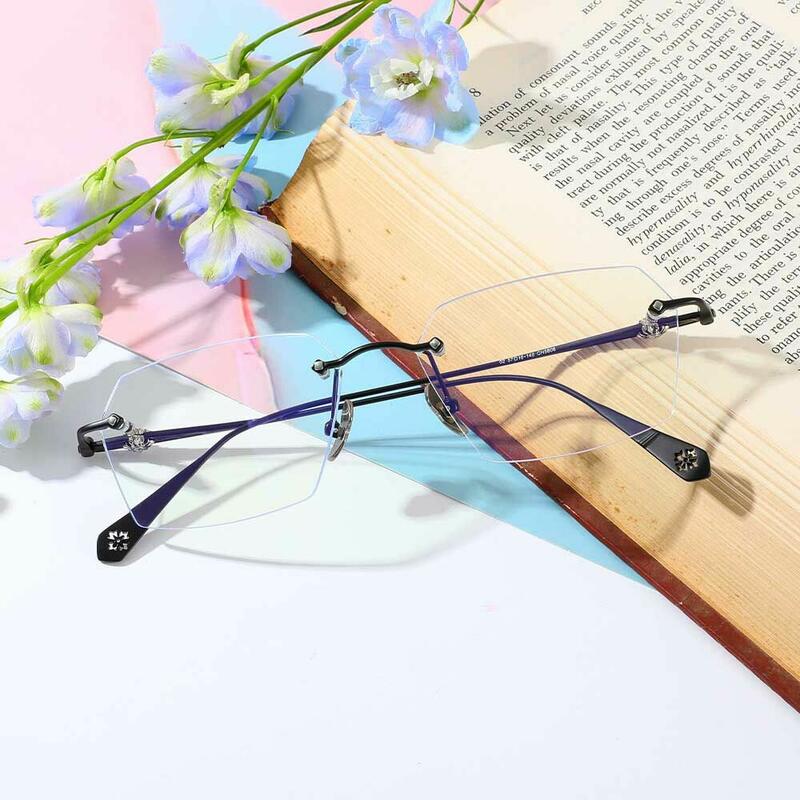
Lens shape works the same way frame shape does, just at lower volume. Soft rectangles — by far the most common rimless cut — balance round and oval faces and read as polished on video calls, which is a real consideration in 2026, not a throwaway line. Subtle cat-eye cuts lift square jawlines without the drama of a full acetate cat-eye. Geometric cuts (hexagons, soft octagons) are the fashion-forward end of rimless, and because the shape is unframed, they come across as architectural rather than loud.
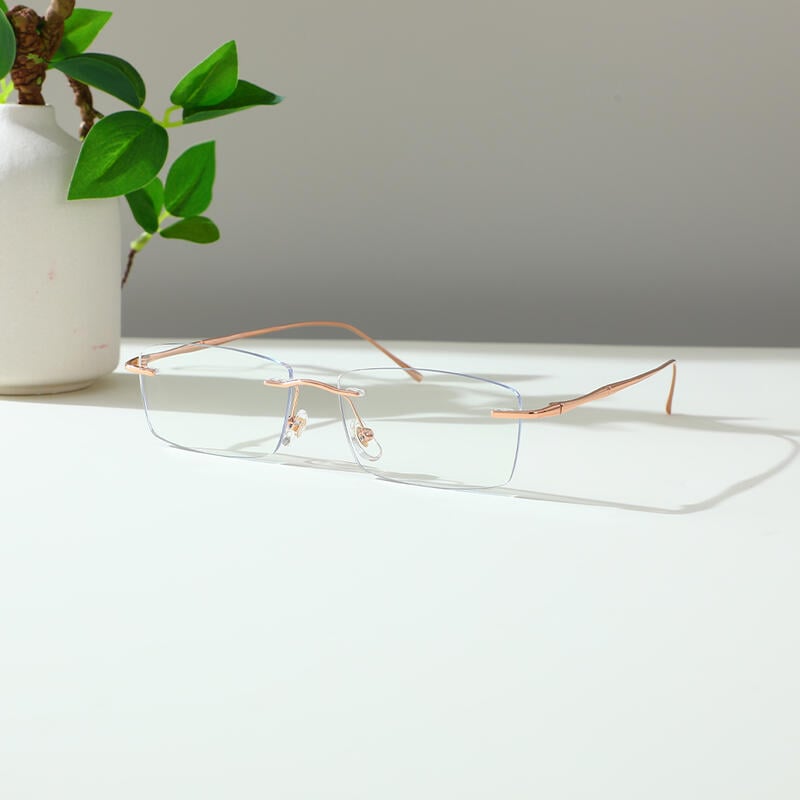
Hardware color is the other lever. Gold and rose gold warm up cool skin tones and photograph beautifully; silver and gunmetal skew classic and disappear against the face. Because the hardware is the only visible metal, a switch from silver to gold changes the character of a rimless pair more than it would on any other frame style.
Then there's material, and here the difference is functional, not cosmetic. Titanium dominates quality rimless eyewear for concrete reasons: it weighs roughly half what conventional alloys do, it doesn't corrode from sweat, sunscreen, or skincare products, and it flexes rather than bends. A rimless frame transfers all mechanical stress through those four drilled mount points, so the material's ability to absorb flex matters more than it does on a rimmed frame. If a rimless pair is priced suspiciously low and doesn't say titanium or beta-titanium anywhere, the savings usually came out of the metal.
Two small features earn their keep on rimless specifically: adjustable nose pads, which let you set the height so the lenses sit level with your pupils (this affects optics, not just comfort), and spring hinges, which take up the shock when you pull the glasses off one-handed — which you will, despite knowing better.
At checkout: the lens options that matter more on rimless
Every online glasses purchase ends with a screen full of lens add-ons. On rimless, two of them stop being optional in any meaningful sense.
Edge polish. Since the lens edge is exposed, an unpolished edge looks frosted and gray from the side. A polished edge looks like glass — clean, nearly invisible. Some retailers include it on rimless orders automatically; if it's listed as an add-on, take it.
Anti-reflective coating. Rimless glasses are chosen for their barely-there look, and nothing ruins that faster than white reflections flashing across the lenses in photos and on Zoom. AR coating is what makes lenses disappear. On a style whose entire point is invisibility, skipping it is self-defeating.
Blue-light filtering, photochromic tints, and the rest remain matters of preference — they behave the same on rimless as on any frame. The two above are the rimless-specific spend.
The first week: what's normal and what isn't
New rimless wearers tend to report the same two impressions. The first is disbelief at the weight — a titanium rimless pair with high-index lenses typically lands under 15 grams, light enough that people genuinely forget they're wearing glasses and pat their head looking for them. The second is a brief period of visual adjustment: with no frame in your peripheral vision, the world feels slightly more open, and for a day or two that openness can read as strange. It passes.
What isn't normal: lenses that sit visibly crooked, a mount point that clicks or shifts when you handle the glasses, or pressure marks on your nose after an hour. Crooked lenses and moving mounts are assembly defects — use the retailer's adjustment or replacement policy rather than living with them, because a loose mount only loosens further. Pressure marks mean the nose pads need widening, a thirty-second adjustment you can do gently with your thumbs or have done free at most optical shops.

Year two and beyond: living with rimless
This is the part almost no one writes about, and it's where rimless ownership actually differs from owning other glasses.
The mounts need an occasional check. The screws or compression fittings at the four drill points can loosen gradually — every few months, hold the glasses by the bridge and check whether either lens wiggles. If it does, most optical shops will retighten rimless mounts in minutes, often free, whether or not you bought the glasses there. A dab of clear nail polish over a screw head is the time-honored home fix for a screw that keeps backing out; opticians have been recommending it for decades.
Cleaning has one extra rule. Spray or rinse first, then wipe — and when you wipe, support the lens you're cleaning rather than gripping the opposite lens and twisting. Torque across the bridge is the one everyday motion that stresses drill mounts. Same cloth, same lens soap as any glasses; just mind where your fingers anchor.
Travel deserves a hard case. Rimless frames handle daily wear better than their delicate reputation suggests — flex-friendly titanium sees to that — but a bag without a case is where rimless pairs actually die, crushed under a laptop rather than snapped in use.
Lifespan, treated this way, runs three to five years or more, usually ending when your prescription changes rather than when the frame fails. And because the frame is just hardware, many rimless pairs can take new lenses in the same mounts — worth asking about before replacing the whole pair.
The style question, briefly
Are rimless glasses in style for women in 2026? Emphatically — they're a fixture of the minimalist, quiet-luxury direction eyewear has taken, favored precisely because they don't announce a trend year. A bold acetate frame timestamps itself; a rimless pair from five years ago looks like a rimless pair from this year. For anyone buying one good pair rather than rotating several, that neutrality is a financial argument, not just an aesthetic one.
What it should cost
Frame-only pricing for rimless glasses for women made with genuine titanium typically ranges from the mid-$20s to around $100 online. Aoolia's women's rimless collection spans $23.95 to $98.95, while designer brands often charge $300 or more for similar titanium construction. Regardless of the price, what you're really paying for comes down to three things: the quality of the titanium, the precision of the rimless mounting system, and whether a qualified optician carefully inspects the finished pair before it ships. That final inspection—checking hole alignment, hardware torque, and lens edge finishing—is especially important for rimless glasses, where assembly quality directly affects durability, comfort, and long-term performance. When shopping for rimless glasses for women, it's worth asking any retailer about this process, because on rimless eyewear, craftsmanship isn't just another feature—it's what defines the product.