
PD: 63 Expires: 07/2027
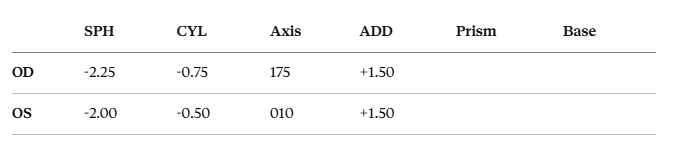
If that grid means nothing to you, you're in good company — prescriptions are written for opticians and lens labs, not for patients. But you don't need optical training to read one. This article decodes that exact sample line by line, then covers the situations where prescriptions get confusing: notation that differs between doctors, the number that's often missing, and the errors people actually make when typing a prescription into an order form for prescription glasses online.
By the end, you'll be able to read the sample above as a full sentence: a mildly nearsighted person with slight astigmatism in both eyes who has reached the age where close-up focus needs help.
Here's how each field gets you there.
OD and OS: which eye is which
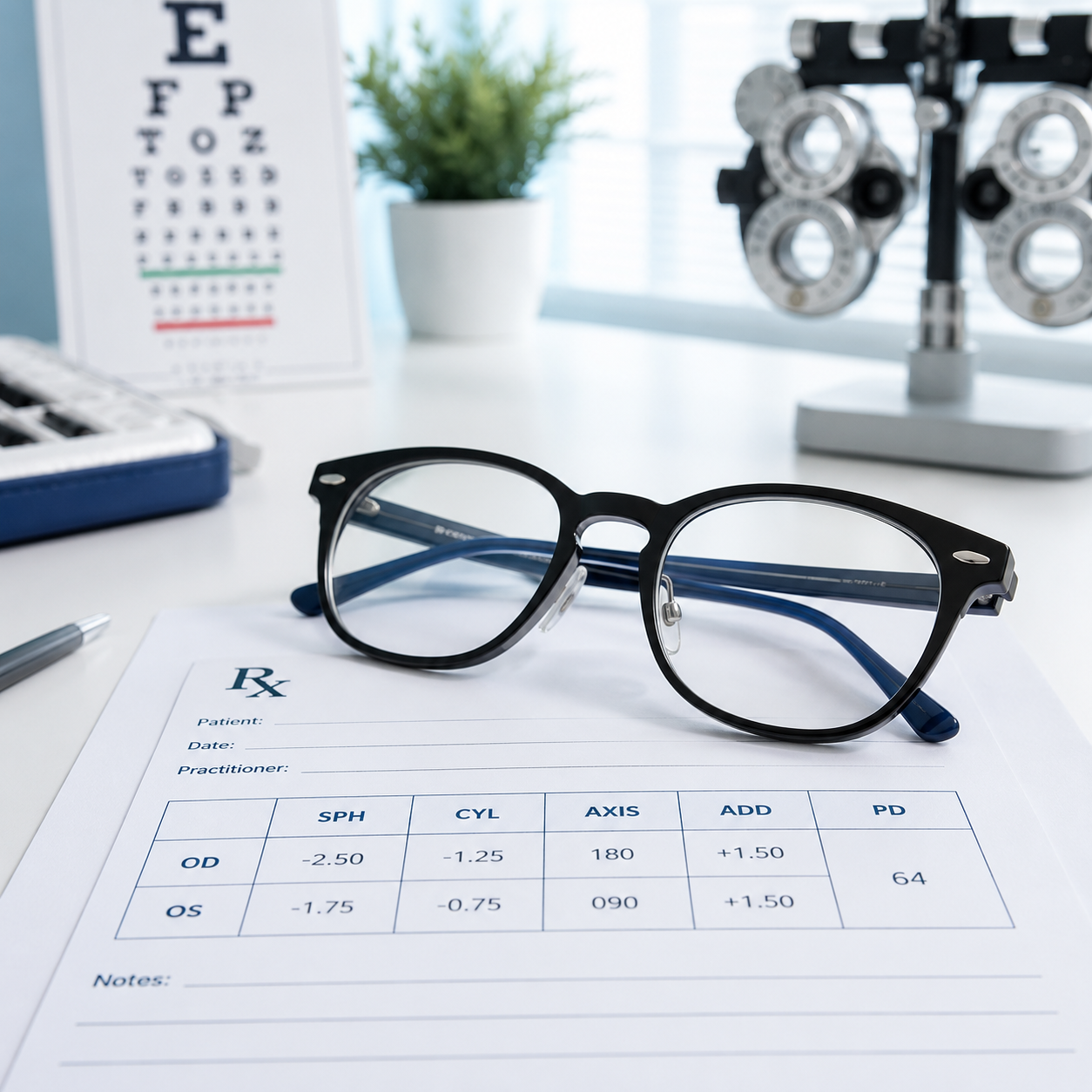
The two rows are your two eyes, labeled in Latin:
OD (oculus dexter) — your right eye
OS (oculus sinister) — your left eye
Right eye is listed first by convention, which trips people up because it's the reverse of how you'd read a face looking at someone. Some clinics skip the Latin and simply print RE/LE or Right/Left — same thing. You may also occasionally see OU (oculus uterque), meaning "both eyes," usually next to a value that applies to both.
This is the single most consequential field to get right when ordering. Swapping OD and OS values puts each lens in front of the wrong eye, and the result is a pair of prescription glasses that technically "works" but feels subtly wrong all day — mild strain, a pulling sensation, headaches by evening. If you ever transfer a prescription by hand, check this field twice.
SPH (Sphere): the main correction
SPH is the core of the prescription — the overall focusing power your eye needs, measured in diopters (D), moving in steps of 0.25.
The sign tells you which direction your vision needs correcting:
A minus sign (−) means nearsightedness (myopia): you see close things fine, distant things blur. Our sample's -2.25 right eye is a typical mild-to-moderate myopic value — road signs are fuzzy, a phone screen is fine.
A plus sign (+) means farsightedness (hyperopia): distance is relatively easier, near work strains.
0.00, "Plano," or "PL" means no spherical correction needed in that eye.
The further from zero, the stronger the correction. A rough sense of scale for minus prescriptions: up to about -3.00 is generally considered mild, -3.00 to -6.00 moderate, beyond -6.00 high. This matters practically, not just clinically — sphere power is the main driver of lens thickness, which is why order forms for prescription glasses ask for your numbers before recommending a lens index. Around -4.00 and beyond, a higher-index lens (1.67, then 1.74 at the strongest end) keeps edges from looking like the bottom of a bottle, especially in larger frames.
One thing SPH does not tell you: whether your eyes are "bad." A -5.00 prescription corrects to sharp vision just like a -1.00 does. The number describes the lens, not your ceiling.
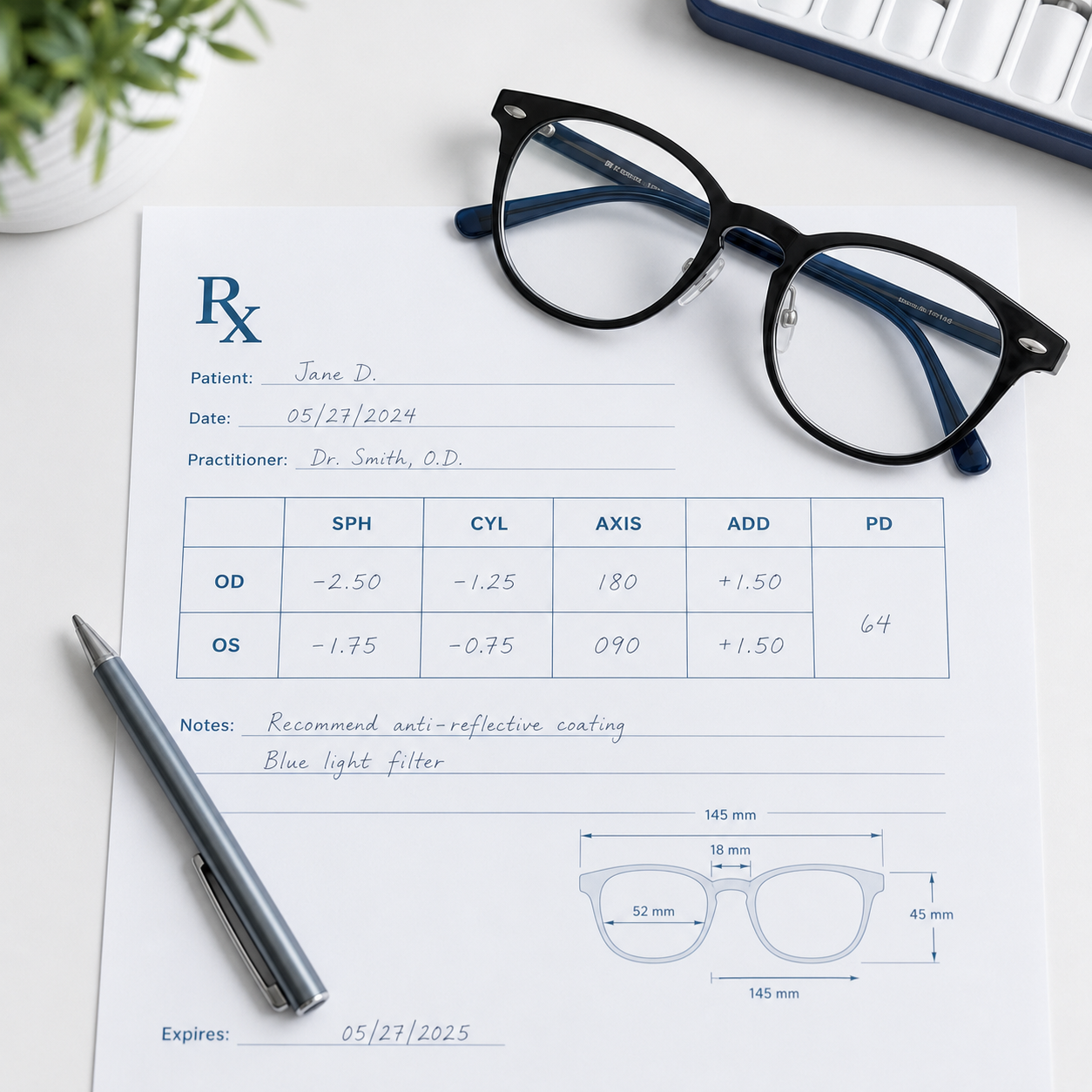
CYL and Axis: the astigmatism pair
These two fields only mean something together, and they're blank if you have no astigmatism.
Astigmatism simply means the front of your eye isn't perfectly round — closer to the side of a spoon than a ball — so light focuses unevenly and things look slightly smeared or doubled at any distance. It's extremely common and usually mild.
CYL (Cylinder) is the amount of extra correction for that unevenness, in diopters. Our sample shows -0.75 and -0.50 — small values; many people carry more without knowing it.
Axis is the orientation of that correction: an angle from 1 to 180 degrees telling the lab where to position the cylinder power on the lens. It's a direction, not a strength. An axis of 175 is not "more" than an axis of 010 — they're just different angles.
Two reading notes that generic guides skip:
Axis is often written with leading zeros — 010, 005 — precisely so nobody misreads a 5 as a 50. When you type it into an online form, "10" and "010" are the same number.
The same astigmatism can be written two ways. Ophthalmologists (MDs) traditionally write cylinder in plus notation; optometrists write it in minus. A prescription of -2.25 / -0.75 × 175 can be mathematically rewritten as -3.00 / +0.75 × 085 — same lens, different arithmetic. So if this year's prescription "looks completely different" from last year's, compare who wrote each one before assuming your eyes changed. Any optician or online retailer's lens lab converts between the two automatically; you don't need to.
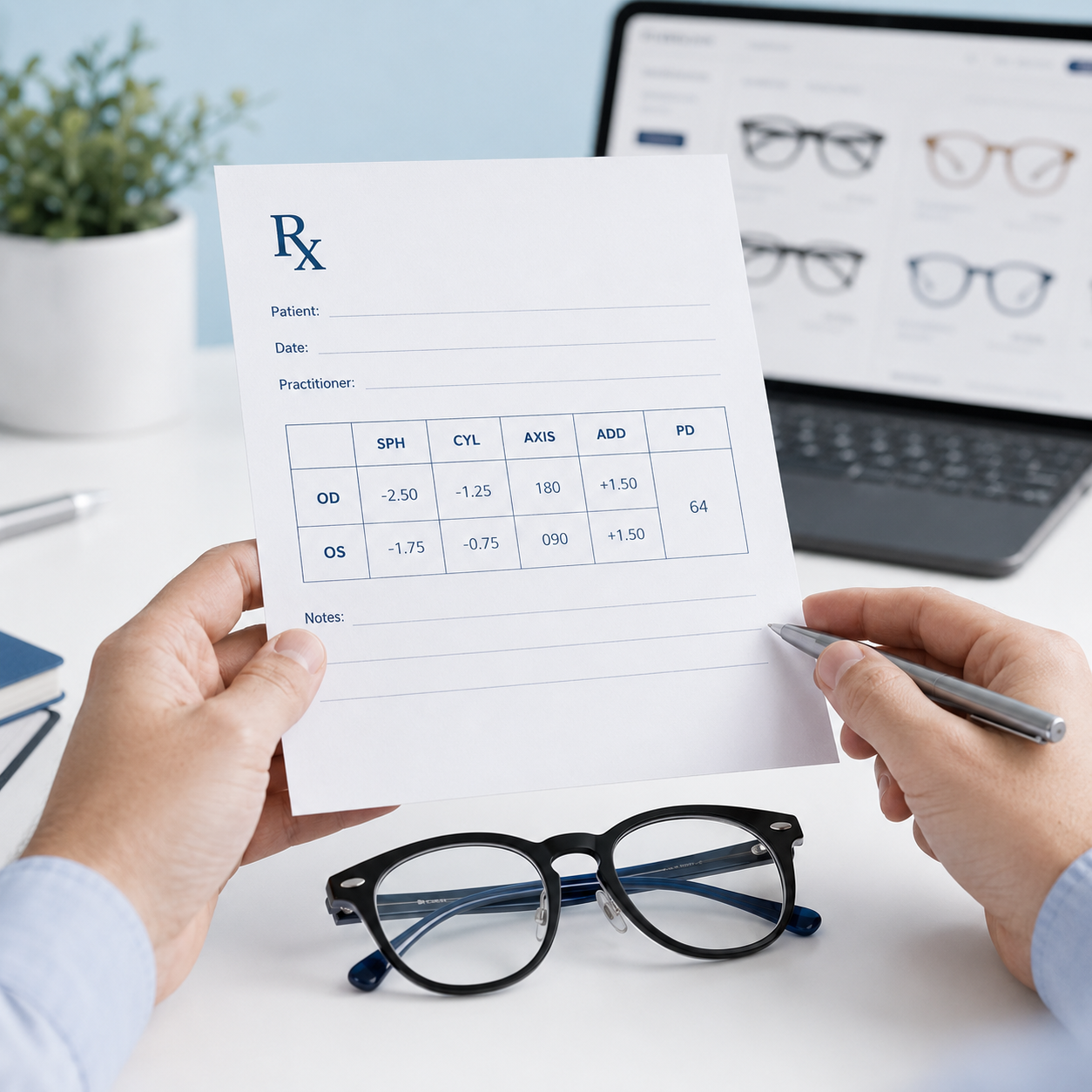
ADD: the reading boost
The +1.50 in our sample's ADD column signals presbyopia — the stiffening of the eye's internal lens that makes close focus harder, typically arriving somewhere in the early-to-mid 40s and progressing until roughly 60. It happens to essentially everyone, including people who never needed glasses before.
ADD ("addition") is extra magnifying power layered on top of the distance prescription for near work. Three things to know:
1.It's always a plus value, even on a strongly minus prescription — and sometimes the + sign is omitted because it's assumed.
2.It's almost always identical for both eyes, which is why some prescriptions print it once rather than per row.
3.It only applies to certain lens types. With an ADD, your prescription can be made into progressives (no visible line, smooth transition between distances), bifocals (visible line, two zones), or dedicated reading glasses (the ADD folded into the sphere for a near-only pair). Single-vision distance glasses simply ignore the ADD.
If your prescription has values in this column and an online order form asks you to choose between "single vision" and "progressive," this is the field that decides whether that choice matters.
Occasionally you'll see NV or NVO (near vision only) noted instead — that's the prescriber saying this prescription is for reading glasses specifically.
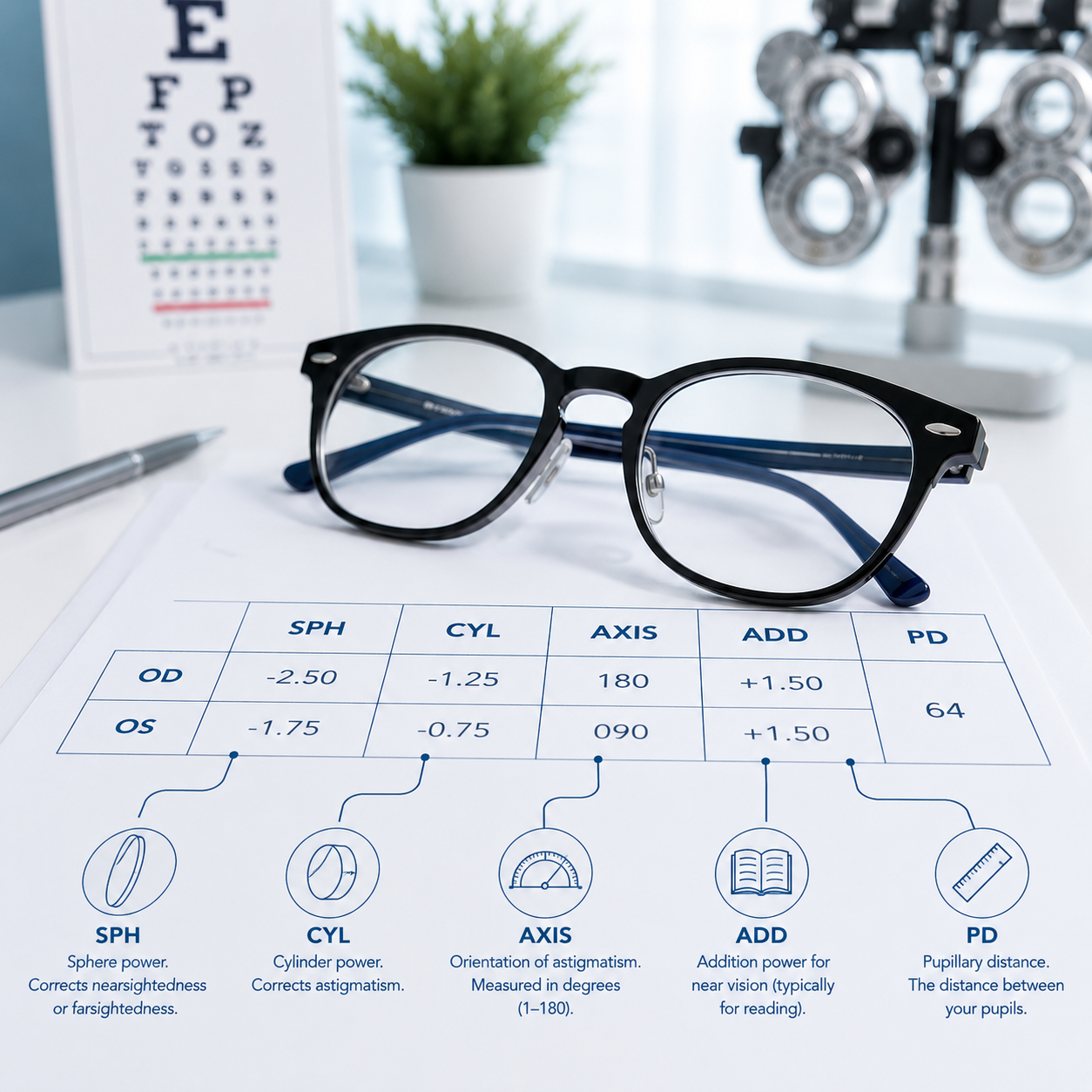
PD: the number that's frequently missing
Pupillary distance — 63 in our sample — is the space between the centers of your pupils in millimeters. The lab uses it to position each lens's optical center directly in front of each eye. Adult PDs mostly fall between 54 and 74 mm.
Here's the part that surprises people: your prescription may not include it. Under the FTC's Eyeglass Rule, US prescribers must give you a copy of your prescription automatically after an exam — but federal rules don't require PD on it, and some offices leave it off. You're entitled to ask for it, and it's reasonable to do so before you leave the exam.
If it's missing and you're ordering prescription glasses online, you have workable options: many retailers (Aoolia included) offer a browser-based measurement tool, or you can measure with a millimeter ruler and a mirror — hold the ruler against your brow, align the zero with the center of one pupil, and read the value at the center of the other. Take it three times and use the number that repeats.
Two format variations worth recognizing:
Dual PD looks like "31.5/31.5" — measured separately from each pupil to the bridge of the nose, because faces aren't perfectly symmetrical. Enter both values if the form allows it; added together they equal the single PD.
A second, smaller number (e.g., "63/60") is distance PD and near PD — your eyes converge slightly when reading. Near PD matters mainly for dedicated reading glasses.
An inaccurate PD won't ruin a mild prescription, but as sphere and cylinder power climb, being a few millimeters off induces unwanted prism — that vague, hard-to-name eyestrain people blame on "cheap lenses" when the lenses were fine and the measurement wasn't.
Prism and Base: the fields most guides skip
Our sample leaves these blank, and most prescriptions do. When filled in, Prism (measured in prism diopters, sometimes written as a superscript triangle) corrects eye alignment rather than focus — it bends light so that two eyes that don't aim at quite the same point can fuse a single image, easing double vision. Base gives the direction of that bend: BU (up), BD (down), BI (in, toward the nose), BO (out).
If your prescription includes prism, treat it as non-optional. It's there because your eyes physically need it, it adds real complexity to lens fabrication, and not every budget retailer fills prism orders. Check that the retailer explicitly supports it before ordering, and expect a modest surcharge.
What your prescription deliberately doesn't say
A prescription specifies the optics — it's silent on everything else about the finished pair, which means several decisions belong to you:
Lens material and index (standard 1.5, polycarbonate, high-index 1.67/1.74) — guided by your SPH, chosen by you
Coatings — anti-reflective, blue-light filtering, photochromic
Frame size and shape — no prescription "requires" a particular frame, though very strong prescriptions look and feel better in smaller lens shapes
Tint — the same numbers can be made into clear eyeglasses or prescription sunglasses
This is also why "my prescription is too strong for that frame" is rarely true in absolute terms — it's a thickness-and-weight tradeoff, not a rule.
Three mix-ups that actually cause problems
A contact lens prescription is not a glasses prescription. They're different documents. Contacts sit directly on the eye; glasses sit about 12 mm in front of it, and at moderate-to-strong powers that distance changes the required correction. A contact prescription also includes base curve (BC) and diameter (DIA) — parameters glasses don't use. If your slip lists BC and DIA, it's for contacts, and entering its values into a glasses order will give you the wrong lenses. You need a separate glasses exam result (usually issued at the same visit).
Dropped signs and swapped fields. The two most common manual-entry errors when ordering online: typing a minus SPH as plus (or vice versa), and entering the CYL value into the Axis box or the reverse. A sanity check helps — CYL values are small and carry a sign; Axis is a whole number from 1 to 180 with no sign. If you're entering "-0.75" where three digits belong, stop. Most retailers also let you upload a photo of the prescription instead, which sidesteps typing entirely and lets a human verify it — the safer route for anything beyond a simple prescription.
Expiration. US glasses prescriptions are typically valid for one to two years depending on the state and the prescriber's judgment, and the expiration date must appear on the document. Retailers verify it. If yours has lapsed, the fix is an updated exam — which is worth doing anyway, since an expired prescription may also be an outdated one, and wearing yesterday's numbers is its own subtle source of strain.
Reading the sample back, start to finish
Return to the prescription at the top of this page. You can now read it fluently: right eye mildly nearsighted (-2.25) with slight astigmatism (-0.75 oriented at 175°); left eye nearly the same, a touch weaker; both eyes need a +1.50 boost for reading, so the wearer will be choosing between progressives and a separate pair of readers; pupils sit 63 mm apart; no prism; valid through July 2027.
That's the entire skill. Every prescription you'll ever hold is a variation of those same fields, and once you can read yours, ordering prescription glasses stops being an act of faith and becomes a form you can fill out — and double-check — with confidence.
Have your numbers in hand? Every frame at Aoolia can be made to your exact prescription — single vision, progressive, or readers — with optician verification on every order, so what you decoded here is exactly what arrives in the lenses.