
You order your first pair of photochromic lenses, wear them on a bright Saturday errand run, and somewhere on the highway you notice something odd: the sun is blasting through the windshield, and your lenses are doing absolutely nothing about it.
Nothing is broken. This is the single most common surprise people have with photochromic lenses, and it comes down to a piece of glass you look through every day but probably never think about.
The short version: photochromic lenses stay mostly clear inside a car because your windshield blocks the UV light they need to activate. They aren't malfunctioning, and they're still doing their job everywhere else. But if sun protection while driving is the main reason you're buying them, you should know that before you check out — not after.
Here's the longer version, including the parts most lens sellers skip.
Your windshield is quietly running interference
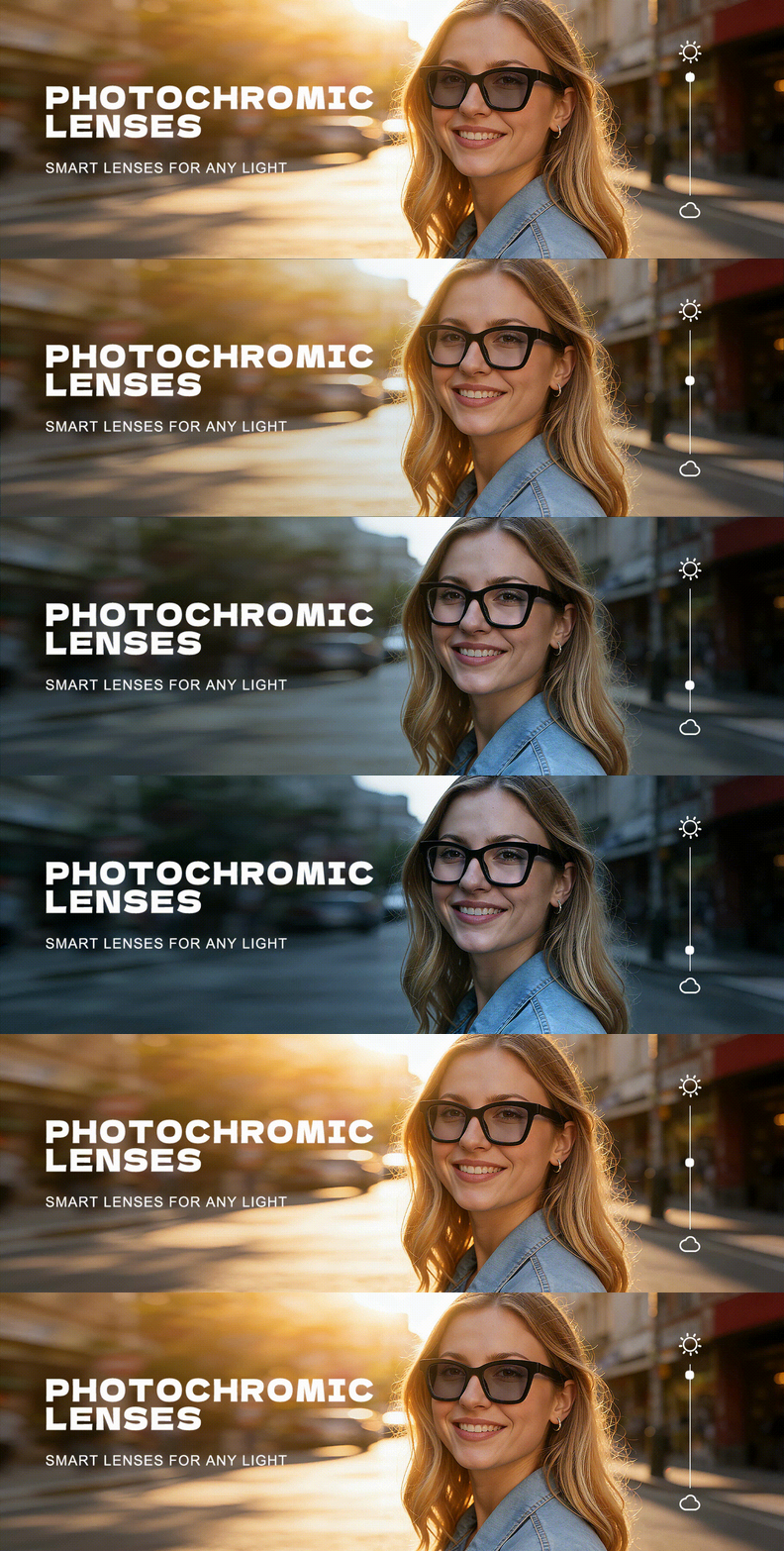
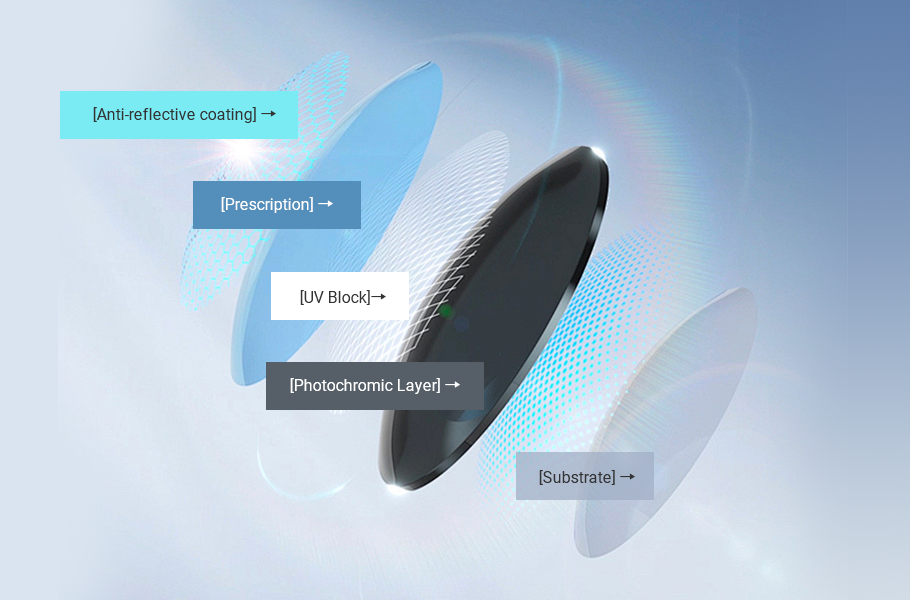
Photochromic lenses darken because of trillions of light-sensitive molecules embedded in the lens. Those molecules don't respond to brightness — a common misconception — they respond to ultraviolet light, mostly in the UVA range. No UV, no color change, no matter how blinding the glare looks to you.
Now the glass. Every windshield sold in the US is laminated: two layers of glass bonded around a plastic interlayer, a design required by federal safety standards so the windshield holds together in a crash. That plastic interlayer happens to be an extremely effective UV filter. A study published in JAMA Ophthalmology measured 29 cars and found windshields blocked about 96% of UVA on average — and essentially all UVB.
So the exact wavelengths your photochromic lenses are waiting for never reach them. The sun feels intense because plenty of visible light gets through. The ultraviolet trigger doesn't.
This is worth sitting with for a second, because it reframes the whole question. The lenses aren't underperforming in the car. The car is performing — arguably too well for your lenses, though not badly for your eyes, since that same interlayer is shielding your skin and corneas from most UV up front.
Four driving situations, four different answers
"Do they work in the car" is really four questions wearing one trench coat. The honest answer changes depending on where you're sitting and when.
1. Behind the windshield, daytime
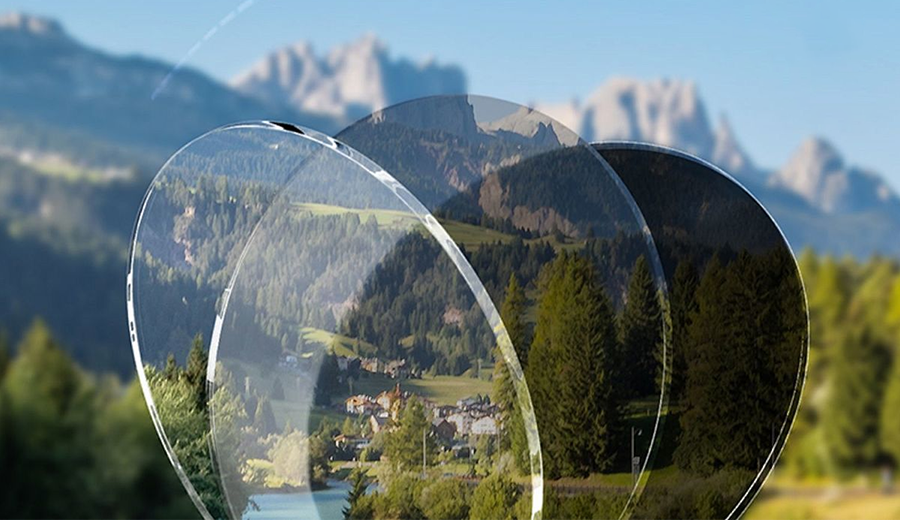
Expect your lenses to stay clear, or pick up a tint so faint you'd need to take them off to notice it. On a long summer drive they may reach maybe 10–20% of their outdoor darkness — nowhere near sunglasses territory. If highway glare bothers you, photochromic lenses alone won't fix it. (Solutions below; there are good ones.)
2. Next to a side window
Here's where it gets less predictable. Side and rear windows are usually tempered glass, not laminated — no UV-blocking interlayer. That same JAMA Ophthalmology study found side windows let through wildly different amounts of UVA depending on the vehicle: some blocked as little as 44%, others as much as 96%.
Practical translation: if you drive with your window cracked, or your car has basic untinted side glass, enough UVA can leak in to give your photochromic lenses a light activation on the window side. Passengers sometimes notice one lens darker than the other. Again — not a defect. It's a live readout of how much UV is actually reaching you, which is oddly useful information: dermatologists point to that side-window gap as the reason left-side sun damage shows up in long-haul drivers.
3. Windows down, convertible, motorcycle, golf cart
Full sun, full UV, full function. With nothing between you and open sky, photochromic lenses behave exactly as they do on a sidewalk: darkening in under a minute, adjusting as clouds move. Motorcyclists with prescription lenses are, quietly, one of the groups photochromic serves best — a helmet visor plus light-adaptive lenses covers dawn-to-dusk rides without swapping eyewear at every fuel stop. (One caveat: some helmet visors and windscreens are themselves UV-treated, which puts you partially back in windshield territory.)
4. Night driving
Flip the worry around: new buyers often ask whether photochromic lenses are too dark for night driving. They aren't. Without UV, the molecules sit in their clear state, so at night you're effectively wearing standard lenses — same clarity, same safety. The only edge case is the first few minutes after you leave a sunny parking lot at dusk: lenses that darkened outside need two to five minutes to fade, a little longer in cold weather. If you've just walked across a bright parking lot to your car, give them a moment before pulling out.
That's the honest matrix. Notice it's not a yes/no — it's "no up front, sometimes on the side, fully in the open, and irrelevant at night."

"But mine darken a little in the car — why?"
A few readers will get to this point convinced their own experience contradicts the physics. Usually one of four things is happening:
Side-window UVA, as above — the most common cause, especially with a window open.
Residual activation. You walked outside, the lenses darkened, and you got into the car before they fully cleared. For the first several minutes of your drive, you're seeing leftover tint, not new activation.
You have a visible-light-reactive lens. A small category of photochromic lenses (marketed specifically for drivers) is engineered to respond to visible light as well as UV, so they do tint behind glass. They're the exception that proves the rule — they exist precisely because standard photochromic lenses don't activate behind a windshield.
An aging lens base tint. Photochromic molecules wear out over years of cycling, and older lenses sometimes retain a permanent faint tint. If your three-year-old pair never looks fully clear anymore, that's age, not activation.
None of these change the core guidance. If glare behind the wheel is your problem, "a little" darkening isn't the fix.
What actually works for sun while driving
This is where we'd rather be straight with you than sell you the wrong thing. Ranked by how well each option solves the driving problem specifically:
Prescription sunglasses. Still the best tool for the job — a fixed, full-depth tint that doesn't care what the windshield filters out. If road glare is a daily issue (commuters driving east at sunrise and west at sunset, we see you), a dedicated pair of [prescription sunglasses] in the car's door pocket beats every workaround. Polarized versions go one better, since polarization specifically cuts the horizontal glare bouncing off asphalt and hoods — a different mechanism from darkening, and one photochromic technology doesn't replicate.
Clip-ons. The budget-and-glovebox answer. A [clip-on] over your regular glasses gives you instant tint on demand and costs a fraction of a second pair. Less elegant, entirely effective.
Driver-specific photochromic lenses. The visible-light-reactive category mentioned above. They solve the windshield problem but bring a trade-off most listings underplay: because they react to visible light, many never go fully clear indoors, keeping a slight tint under office lighting. Whether that bothers you is personal. Check the current lens options on any frame's ordering page to see what's available at Aoolia before assuming either way — and if in-car performance is your top priority, compare that residual indoor tint against simply owning two pairs.
The combo most people land on: photochromic lenses as your everyday pair, plus either sunglasses or a clip-on living in the car. Total honesty — that second item might cost less than upgrading to a specialty lens, and each tool does its one job perfectly.
Where photochromic lenses still earn their keep
It would be a strange conclusion to say "skip them" — because outside the car, the case is as strong as ever. [Photochromic lenses] cover the dozens of daily transitions a driver's day surrounds: the walk to the parking lot, the kids' soccer game, the lunch patio, the dog park, the school pickup line where you're standing outside the car for twenty minutes. They block 100% of UVA and UVB the moment you step into open daylight, and they spare you the where-are-my-sunglasses shuffle everywhere except behind the wheel.
Buy them for what they do brilliantly. Pair them with the right tool for the one place physics gets in the way. And the next time your lenses stay stubbornly clear on a sunny highway, you'll know: that's not a flaw. That's your windshield, doing its job a little too thoroughly.