
Part 1: Read your own result slip first
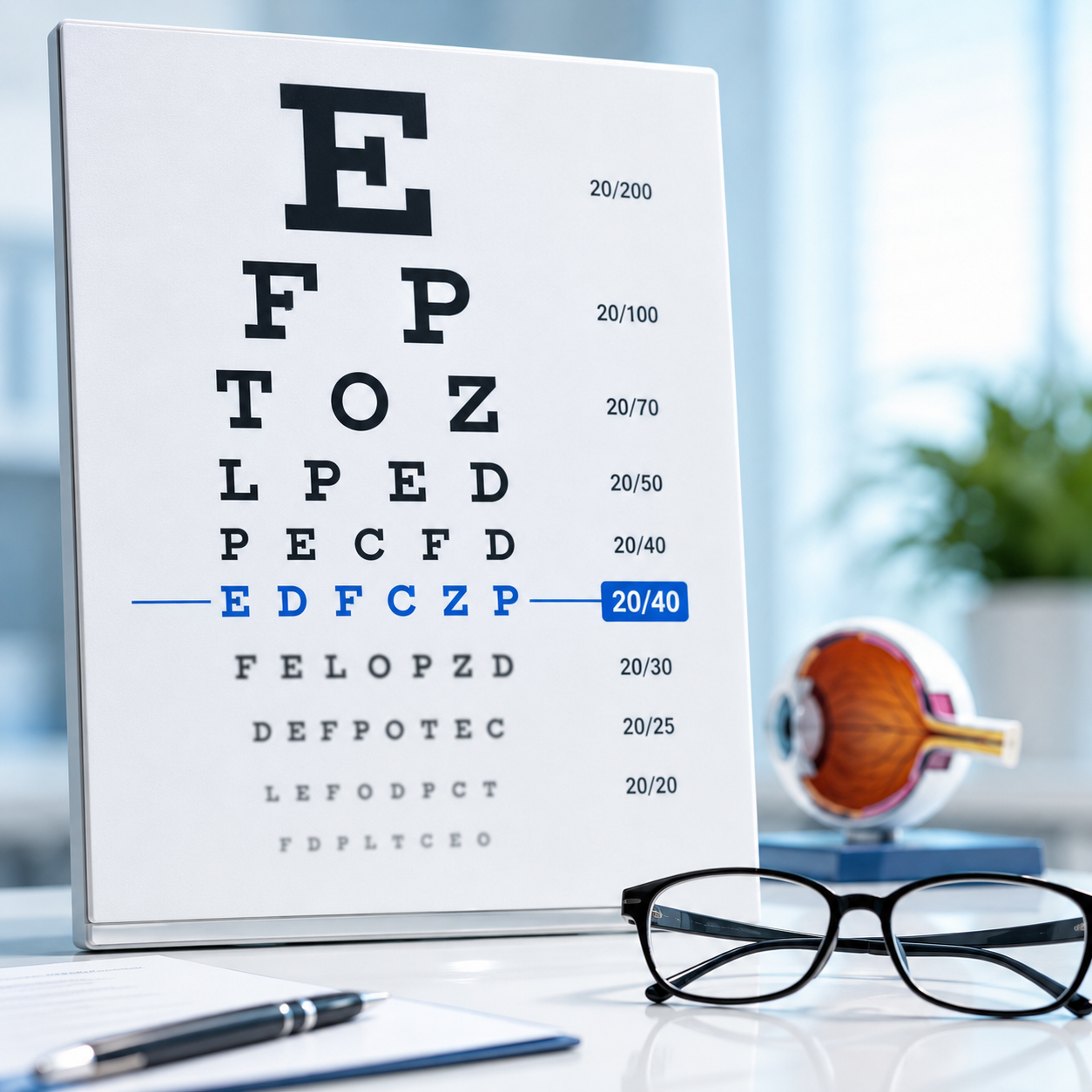
A Snellen fraction is a comparison, not a percentage. The top number is your testing distance in feet — twenty, almost always, sometimes simulated with mirrors in a small exam lane. The bottom number is the distance at which a reference observer could read the same line. So 20/40 eye vision means the smallest row you could resolve at 20 feet is a row that a reference eye resolves at 40 feet. Your detail threshold is roughly half as fine.
That much is in every article on the subject. What isn't is the shorthand printed around the number, which is where the actual meaning lives.
OD, OS, OU. Right eye, left eye, both together. Latin abbreviations that persist because they're compact. 20/40 in OD alone is a very different situation from 20/40 in OU.
sc and cc. Sine correctione and cum correctione — without correction and with correction. This is the single most consequential mark on the page. VAsc 20/40 means your bare eye reads the 40 line. VAcc 20/40 means that even in your current glasses or contacts, the 40 line is where you stop. The first is usually a lens problem. The second usually is not.
PH. Pinhole acuity. If the examiner had you look through a card punched with a small hole and your reading improved to 20/25 or 20/20, that's a strong signal the blur is refractive — a focusing error a lens can neutralize. If the pinhole changed nothing, the limiting factor is somewhere else in the visual system.
The trailing minus or plus. 20/40 -2 means you read the 40 line but missed two optotypes on it. 20/40 +1 means you read all of it plus one letter from the next line down. Clinicians use these to track small changes over time. A drift from 20/40 +2 to 20/40 -3 across two visits is real movement even though the headline fraction never changed.
The gap between eyes. Two lines of difference between OD and OS is treated as clinically meaningful in pediatric protocols, and it's worth asking about at any age. 20/20 in one eye and 20/40 in the other is a pattern; 20/40 in both is a different pattern.
Pull out your slip. If you can answer corrected or uncorrected, one eye or both, and did pinhole help, you already know more about your result than nearly anything you'll read online.

Part 2: The fork in the road — uncorrected 20/40 vs. best-corrected 20/40
Everything downstream depends on which of these you have.
Uncorrected 20/40 (VAsc)
You were tested with nothing in front of your eye and landed on the 40 line. In adults this is most often mild myopia, low astigmatism, or a combination — the eye's optics are focusing light slightly off the retinal plane. Sometimes it's uncorrected hyperopia in someone whose focusing reserve is starting to fade in their forties.
This is the version of 20/40 that a properly made pair of lenses typically resolves in about a second. The number describes the optics in front of the retina, not the health of the eye behind it.
Best-corrected 20/40 (VAcc, or BCVA)
You were tested through the best lens combination the refraction could produce, and 40 is still the line. Lenses have already done what lenses can do. Something inside the eye or the visual pathway is capping the result.
The usual candidates, roughly in order of frequency by age group:
Amblyopia — a developmental difference where one eye's pathway didn't fully mature. Common cause of a stable, lifelong 20/40 in one eye with no other symptoms.
Early lens changes — cataract, especially the subcapsular type, which can wreck night vision and glare tolerance long before it flattens the chart number.
Dry eye and tear film instability — genuinely underrated. An unstable tear film scatters light and can cost a line of acuity that fluctuates through the day.
Corneal irregularity — keratoconus, scarring, post-surgical shape changes. Often shows up as acuity that a standard spectacle lens can't reach but a rigid contact lens can.
Retinal or macular changes — the reason a new, unexplained drop in best-corrected acuity is never something to sit on.
A best-corrected 20/40 that has been stable for a decade and a best-corrected 20/40 that appeared this spring are not the same finding, even though the slip looks identical. Duration is the question your eye doctor will ask first, so have the answer ready.
Part 3: Where the 20/40 line actually appears in U.S. rules
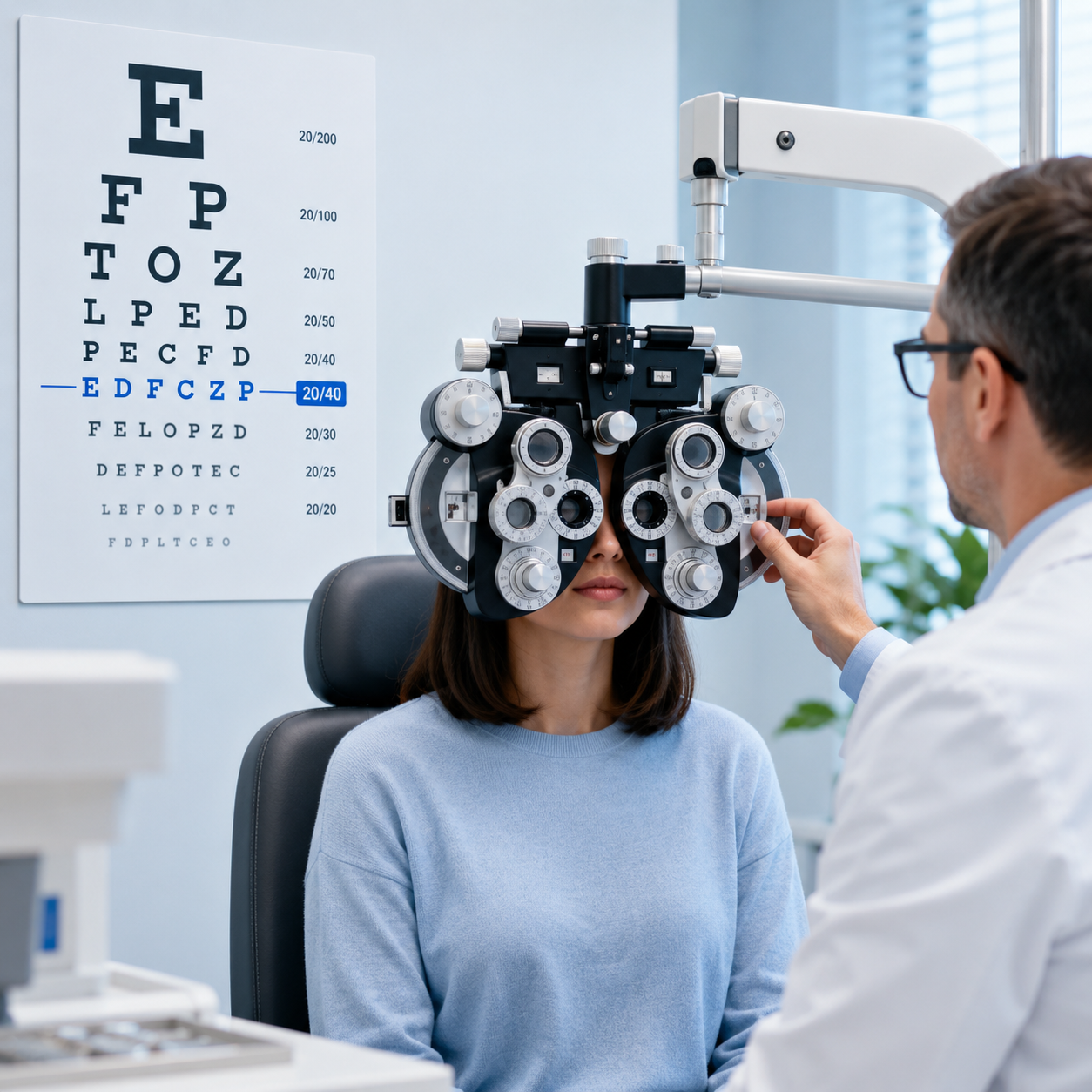
This is why the number carries so much weight. It functions as an administrative threshold across several unrelated systems.
Driver licensing
Most states set 20/40 as the acuity floor for an unrestricted license, measured with or without corrective lenses. New York, for example, requires at least 20/40 on the Snellen scale in either eye or both, with or without correction, and accepts results submitted electronically by an enrolled provider. Wisconsin pairs 20/40 acuity with a 70-degree field requirement and notes that the standard was set on research plus input from state ophthalmologists and optometrists — it isn't an arbitrary round number.
The variation between states is real and worth checking rather than assuming:
Some states test each eye separately as well as together, with different thresholds depending on how poor the weaker eye is.
Maryland frames its unrestricted standard around vision without corrective lenses, and issues restricted licenses in the band between 20/40 and 20/70.
Some jurisdictions restrict drivers who fall just past 20/40 to daylight driving only.
Bioptic telescopes are permitted in some states and explicitly excluded from meeting the standard in others.
The practical point most people miss: if you reach 20/40 only while wearing correction, you meet the standard — you simply get a corrective-lens restriction on the license, and you're required to wear them behind the wheel. That restriction can usually be removed later by submitting a vision exam form showing you now meet the standard unaided, whether through a change in the eyes or refractive surgery.
Commercial driving is stricter. Federal standards call for at least 20/40 in each eye and a 70-degree field in each eye, with an alternative vision program administered through a DOT medical examiner for drivers who don't meet it.
Aviation medicals
The FAA uses 20/40 as a threshold in several places. Third-class certificates — the private pilot tier — require 20/40 or better for distance and near. First- and second-class certificates require 20/20 distance in each eye separately, but the near standard at 16 inches is 20/40, and pilots 50 and older must also meet 20/40 at 32 inches for intermediate vision. Correction is permitted throughout; the certificate simply carries a lens requirement, and a spare pair is expected on board.
Pediatric screening
Children are held to age-indexed thresholds, not a single number, because acuity is still developing. Current U.S. preschool screening guidance sets the pass criteria at 20/50 or better for three-year-olds, 20/40 or better for four-year-olds, and 20/32 or better from age five up. Referral guidance also flags a two-line difference between the eyes regardless of the absolute numbers.
So a 20/40 result on a school screening means something completely different at four than at eight. At four it may be entirely age-appropriate. At eight it's a referral.
Cataract surgery and insurance — a myth worth correcting
You will read, repeatedly, that Medicare requires vision to fall to 20/40 or worse before it will cover cataract surgery. That is a distortion of how coverage actually works.
There is no national coverage determination setting a specific acuity cutoff for cataract surgery, and most Medicare Administrative Contractors do not impose one — though at least one has used a 20/40 threshold in its own documentation standards. Medicare's own coverage language acknowledges that high-contrast letters read in a darkened room can understate the functional impairment a cataract causes in glare, low contrast, night driving, and reading. Coverage decisions turn on documented functional impairment that glasses cannot fix, not on a chart line alone.
Separately, 20/40 shows up on the outcome side: the national quality measure for uncomplicated cataract surgery tracks the share of patients reaching best-corrected 20/40 or better within 90 days. It's the benchmark for a good result, not a gate for approval.
These are reference points, not legal advice. Licensing rules change and vary by state; medical coverage varies by plan and contractor. Verify with your own state agency, examiner, or insurer.
Part 4: What 20/40 eye vision means at your age
The same fraction has a different differential diagnosis at every stage of life.
Ages 3–5. Frequently normal. Acuity is still maturing, and screening thresholds reflect that. What matters more than the number is asymmetry between the eyes, a family history of amblyopia or strabismus, or a child who squints, tilts, or covers one eye. Referral windows matter here — treatment outcomes for amblyopia are strongly age-sensitive, and earlier is meaningfully better.
Ages 6–17. A 20/40 result at this age is usually early myopia, and usually the first of several. The number is less important than the trajectory: how much it moves per year, and whether the child's near-work and outdoor-time patterns are contributing. This is the age group where a full cycloplegic exam — not a school screening — actually answers the question.
Ages 18–39. Almost always uncorrected refractive error. If it's a change from a known 20/20, and especially if it's sudden or in one eye, that changes the urgency considerably. Stable low myopia that's been drifting for years is a lens conversation. A two-month change is an exam conversation.
Ages 40–55. The confusing decade. Distance acuity of 20/40 can coexist with the first stages of presbyopia, and people often conflate the two — "my eyes are going" gets applied to two unrelated changes at once. Distance blur and near blur have different causes and different solutions, and it's worth being precise about which one is actually bothering you. If it's both, progressive lenses exist for exactly this overlap.
Ages 55+. Cataract moves up the list substantially, as do macular and other retinal changes. The tell is usually the mismatch: someone reads 20/40 on the chart but describes glare halos around oncoming headlights, needing far more light to read than they used to, or colors looking washed out. That mismatch is the finding, not the fraction.
Part 5: Three things 20/40 does not measure
Visual acuity is a single, narrow measurement: the smallest high-contrast black shape you can resolve, in a controlled room, at one fixed distance, holding still. Real seeing involves considerably more.
Contrast sensitivity. The ability to distinguish shapes from a background of similar brightness — grey car against grey road at dusk, curb against wet pavement, a step edge in a dim stairwell. Contrast sensitivity can be substantially degraded in someone who still reads 20/40 or better. This is exactly the gap Medicare's own coverage guidance acknowledges when it notes that Snellen testing can understate real-world impairment.
Glare recovery and disability glare. How much scattered light degrades your vision, and how long it takes to recover after oncoming headlights. Cataract, dry eye, and corneal haze all hit this hard while barely touching the chart.
Visual field, binocularity, and depth. Where you can see, whether the two eyes work as a team, and how well you judge distance. Field loss in particular can be extensive before a person notices, which is why many state licensing standards specify a field requirement alongside the acuity number.
If your 20/40 comes with symptoms that the number doesn't seem to justify, say so out loud at your exam. Describing the symptom is what prompts the tests that measure the thing actually bothering you.
Part 6: "What prescription is 20/40 vision?" — the conversion that doesn't exist
There are calculators all over the internet that convert diopters into a Snellen fraction with a tidy formula. They are estimates built on a shaky assumption, and they fail routinely.
Acuity and refractive error are related but not equivalent. The same amount of myopia produces different acuity in different people depending on astigmatism amount and axis, pupil size, corneal clarity, tear film quality, retinal health, age, and the lighting conditions of the test. Two people with identical −1.00 D prescriptions can test a line and a half apart.
The rough anchor, offered with the caveat that it's rough: uncorrected acuity in the 20/40 range often corresponds to somewhere in the neighborhood of −0.75 D to −1.00 D of myopia. It also frequently doesn't. Astigmatism in particular skews the relationship badly, because the blur it creates is directional rather than uniform.
Why this matters practically: never order lenses from a number you reverse-engineered from a chart result. A prescription is a specification with sphere, cylinder, axis, and often add power and prism — none of which a Snellen fraction contains. If you want to understand what's on your own script, we've broken the notation down in how to read your glasses prescription.
Part 7: Can 20/40 be improved?
It depends entirely on the Part 2 fork.
If it's refractive, yes, and usually completely. Spectacle lenses, contact lenses, or refractive surgery correct the optics. There's nothing to rehabilitate — the eye is fine, the focus is off.
If it's amblyopia, treatment outcomes are strongly age-dependent, with the best results in childhood. Some improvement is achievable later, but expectations should be set with an eye care provider rather than an article.
If it's cataract, surgery is the treatment, and the outcome benchmark is best-corrected 20/40 or better within three months.
If it's dry eye or tear film, treating the surface can recover a line of acuity that lenses alone never touched. This one is regularly missed.
What won't help: eye exercises marketed as a way to reduce a refractive prescription, "vision training" apps aimed at eliminating glasses, and supplements sold on that premise. Vision therapy has legitimate applications — convergence insufficiency and certain binocular disorders among them — but reversing myopia in an adult eye is not one of them. The axial length of the eye does not shorten because you did an exercise.
Part 8: What to actually do this week
Get a comprehensive eye exam, not a screening. A screening — at school, at work, at the DMV, in a pharmacy — is designed to sort people into "fine" and "go see someone." It cannot tell you why. If your 20/40 came from a screening, it hasn't been diagnosed yet.
Ask these three questions at the exam. They're specific enough to get specific answers:
Is my 20/40 corrected or uncorrected, and what did pinhole show?
Is my best-corrected acuity 20/20, and if not, what's limiting it?
Has anything changed since my last exam, and how fast?
Get your prescription and your PD. Under the FTC's Eyeglass Rule, U.S. patients are entitled to a copy of their spectacle prescription after a refraction, at no extra charge and without needing to ask twice. Pupillary distance is worth requesting at the same time if you plan to order lenses anywhere other than the exam room.
Know the red flags. Same-day care, not a scheduled appointment, for: sudden vision change; a change in one eye only; straight lines appearing bent or wavy; a curtain or shadow across part of your field; a shower of new floaters or flashes; eye pain; or halos with headache and nausea.
If it's refractive: getting lenses that actually deliver 20/20
Correcting a mild prescription sounds trivial and often isn't executed well. A few things separate lenses that work from lenses that technically match the script:
Accuracy of the prescription itself, including cylinder axis. A few degrees of axis error on a modest astigmatism correction is enough to leave someone hovering near 20/30.
Pupillary distance and optical centering. Lenses whose optical centers don't line up with your pupils induce unwanted prism. On low prescriptions this shows up as eye strain rather than blur, which makes it easy to blame the wrong thing.
Anti-reflective coating, particularly if your complaint is night driving. Internal lens reflections add glare that a stronger prescription won't fix. Our driving lens options cover this in more depth.
Frame fit. Vertex distance and pantoscopic tilt change effective lens power. A frame that slides down your nose changes your prescription throughout the day.
At Aoolia, every prescription order is checked by a licensed optician before the lenses are cut, and our virtual try-on exists so that fit is a decision you make before the frames ship rather than after. The exam is the part that can't move online — but once you're holding a valid prescription, the lens work doesn't need to cost what it traditionally has.
Browse prescription glasses once you have your script in hand.
Common questions
Is 20/40 eye vision considered legally blind? No, not remotely. Legal blindness in the U.S. is defined as best-corrected acuity of 20/200 or worse in the better eye, or a visual field of 20 degrees or less. 20/40 is roughly five chart lines away from that threshold.
Can I pass a DMV vision test with 20/40? In most states, yes — 20/40 is typically the standard for an unrestricted license, and correction counts. If you reach it only with glasses or contacts, expect a corrective-lens restriction on the license. Rules vary by state, so confirm with your own licensing agency.
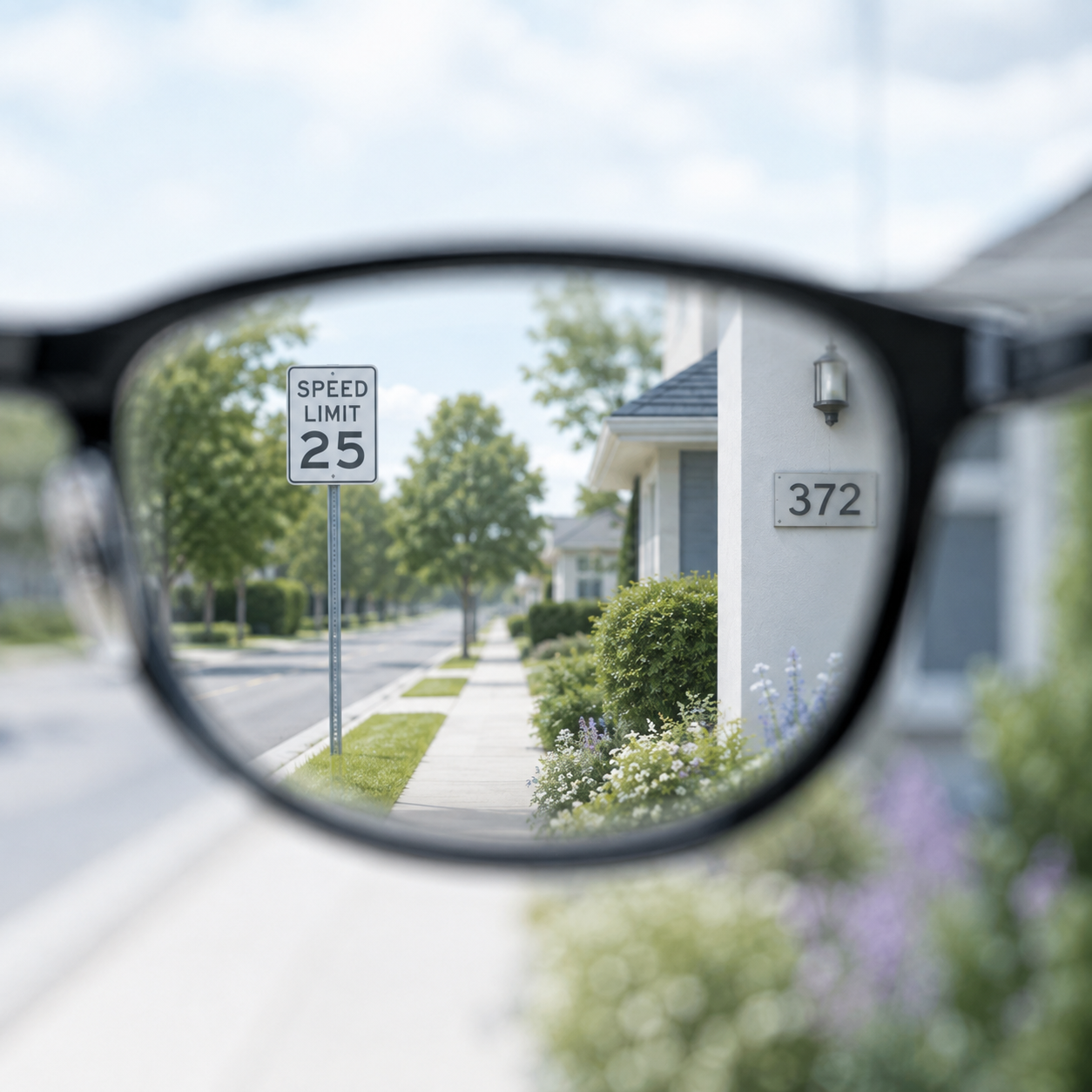
Do I need glasses if I have 20/40 vision? Legally, often no. Practically, it depends on what you do. 20/40 is enough to read most highway signage in daylight and get through a normal workday. It is frequently not enough for comfortable night driving, a lecture hall, or a job with visual demands — and the fatigue cost of squinting through a mild uncorrected error is real even when the chart says you're fine.
Is 20/40 in one eye a problem? It needs an explanation more than the same number in both eyes does. A long-standing 20/40 in one eye is often amblyopia. A new one is a reason to be seen promptly. Either way, ask about the two-line difference specifically.
Does 20/40 vision get worse over time? The number isn't a trajectory. What matters is the cause — mild myopia in a teenager and stable amblyopia in a 50-year-old behave completely differently. Establishing the cause is what makes the future predictable.
Sources
New York State DMV — Vision Requirements and Restrictions
Wisconsin DOT — Driver License Vision Standards
Maryland MVA — Vision Requirements (including FMCSA commercial standards and the alternative vision program)
Prevent Blindness / Living Well With Low Vision — State Vision Screening and Standards for License to Drive
FAA / Aerospace Medical Association — Vision and FAA Standards
National Center for Children's Vision and Eye Health — Recommended practices for vision screening in preschool-age children, 2025 update
CMS Medicare Coverage Database — LCD L34413, Cataract Surgery
American Academy of Ophthalmology, EyeNet — How to Document the Need for Cataract Surgery
CMS Quality Payment Program — Quality Measure #191, best-corrected 20/40 or better within 90 days following cataract surgery
U.S. Federal Trade Commission — Eyeglass Rule
This article is general information about how visual acuity measurements are used, not medical advice, and it does not diagnose any condition. Licensing and coverage rules vary by state, agency, and insurer. Consult a licensed optometrist or ophthalmologist about your own eyes.